Alina of the Arena Beginner Guide: Positioning, Stamina, and Survival Tips
Learn how to survive early fights in Alina of the Arena by reading hexes, managing stamina, using knockback, and drafting cards that fix bad board states.
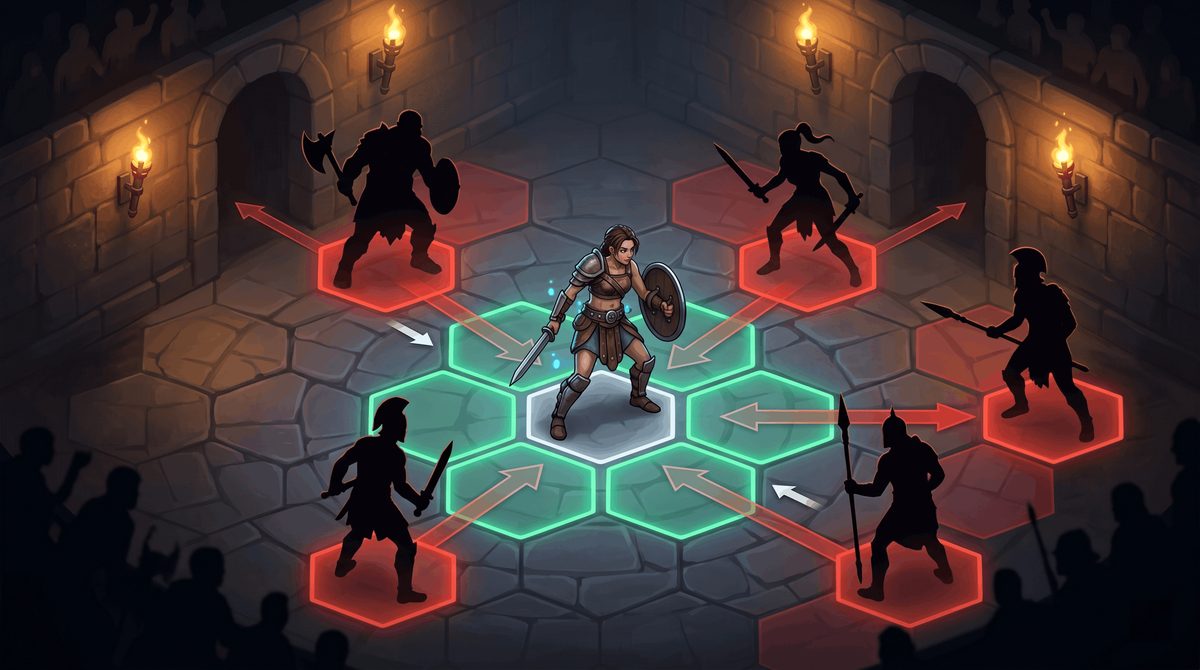
Most early Alina of the Arena deaths do not come from a bad deck.
They come from bad hexes.
Your cards look fine. Your damage looks fine. Then the arena traps you in a position you cannot fix, your stamina is gone, and the next enemy turn punishes every sloppy choice you made two turns earlier.
That is the beginner wall.
Alina of the Arena is a positioning game first and a deckbuilder second. Drafting matters, but beginner runs usually fall apart because of bad movement, bad facing, wasted stamina, and turns that chase damage while ignoring escape routes.
This guide is about fixing that.
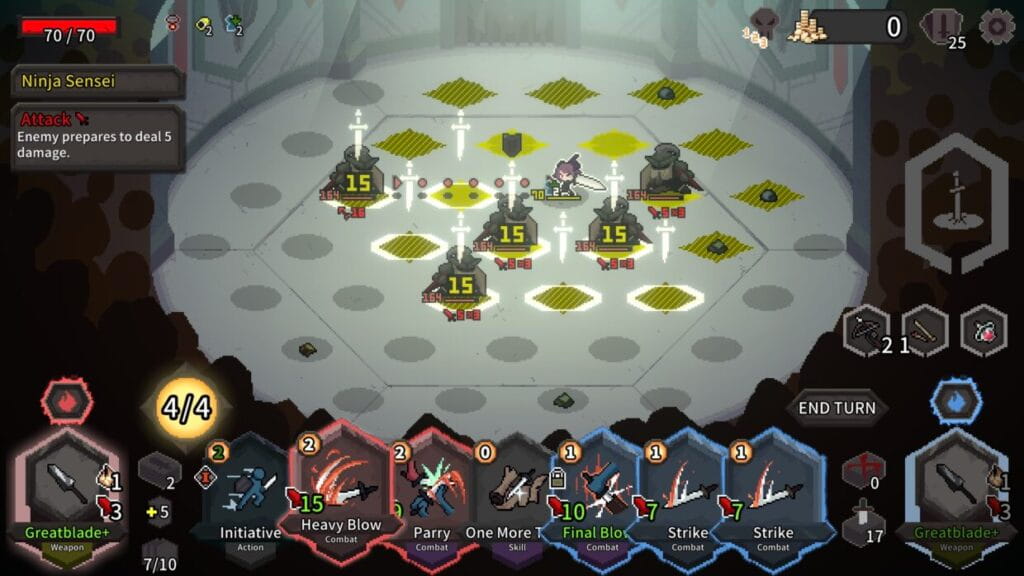
Quick beginner rules
If you are dying early, start with these rules:
- Read enemy intent before reading your hand.
- Pick your safe ending hex before playing damage.
- Do not spend your last stamina unless the board is already stable.
- Treat knockback as defense, not bonus damage.
- Avoid corners unless you control the exit.
- Draft cards that fix bad board states, not just cards that hit harder.
- Stop building perfect turns that only work when the arena is already clean.
The goal is not to play scared.
The goal is to stop handing the game free damage.
The beginner mindset: win the board before you win the draft
Alina punishes lazy positioning harder than weak drafting.
A strong card played from the wrong hex can still get you surrounded. A modest card played from the right angle can prevent damage, break an enemy attack, and set up the next turn.
Before asking, "What is my best card?", ask:
- Which enemy attacks are actually threatening me?
- Which hexes will be unsafe after this turn?
- Can I move an enemy instead of moving myself?
- Where do I want to end, not just where do I want to hit?
- If I spend all my stamina now, what happens if the next draw is awkward?
That last question is brutal.
Alina rewards strong turns, but it punishes overcommitted turns. If you spend everything for damage and end in a bad lane, the next hand may not have the exact movement, defense, or control you need.
A good turn is not only the turn that deals the most damage.
A good turn is the one that leaves you alive with options.
Read the arena before you read your hand
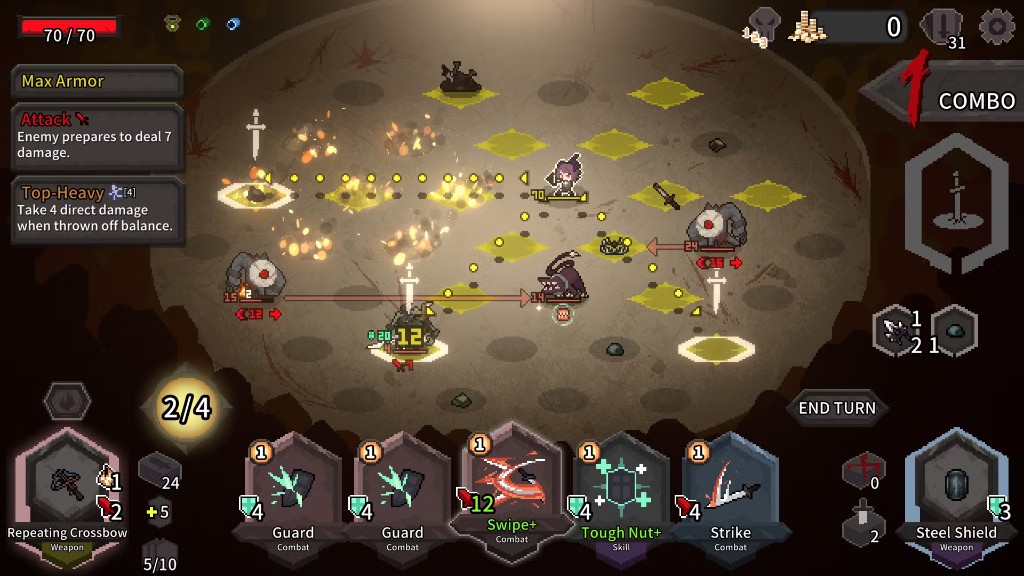
A strong turn starts with the board state, not the cards.
When the turn begins, slow down and identify danger first. Look at enemy intent, attack direction, reachable hexes, walls, edges, and knockback angles.
The goal is not only to avoid current damage. The goal is to avoid ending in a place where next turn has no clean exits.
Use this quick scan:
- Immediate danger: Which attacks will hit you if you do nothing?
- Escape hexes: Where can you stand safely after acting?
- Enemy lanes: Which lines or arcs can enemies threaten next?
- Walls and edges: Which spaces limit your movement if you move there?
- Knockback angles: Can you push an enemy out of range, into a wall, or into another bad position?
This is the core of Alina of the Arena positioning.
You are not just choosing a card sequence. You are choosing what the next board will look like.
A common beginner mistake is playing attacks first, then trying to clean up the position afterward.
Reverse it.
Find the safe ending position first. Then spend the remaining stamina on attacks.
Stamina is a safety budget, not just a damage budget
If you spend all your stamina every turn, Alina will eventually hand you a board state you cannot escape.
That does not mean you should float stamina constantly. It means you should understand what each point is buying.
Sometimes stamina buys damage.
Sometimes it buys movement.
Sometimes it buys the ability to correct a bad angle, avoid being boxed in, or prevent a future hit before it becomes unavoidable.
The safest beginner rule is simple:
Do not spend your last stamina unless the board is already solved.
The board is solved when one of these is true:
- No enemy can hit you.
- The enemy that could hit you is dead.
- You have moved or pushed the threat out of position.
- You are ending on a hex with a realistic next-turn escape.
- The damage you take is intentional and worth the trade.
The dangerous play is spending your final stamina to squeeze in a non-lethal hit while standing in a lane that needs correction.
That play feels efficient.
It is usually greed wearing a fake mustache.
Stamina discipline also changes how you evaluate hands. A hand full of expensive attacks may look powerful, but if it cannot reposition you, it can be worse than a weaker hand with one clean movement or knockback option.
Knockback is prevention, not a bonus effect
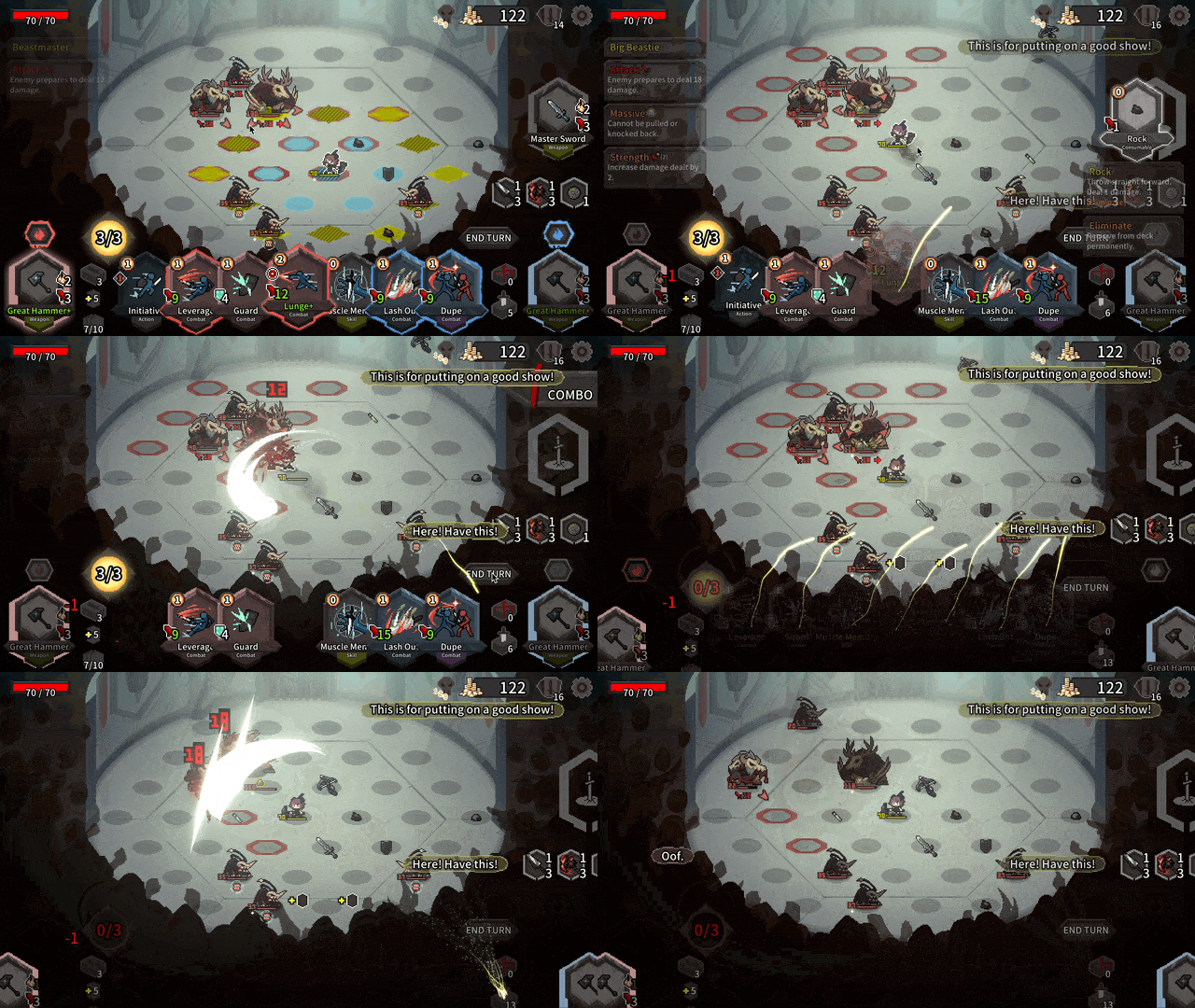
Knockback is not just extra value in Alina of the Arena.
It is one of the safest forms of damage prevention.
Moving the enemy can solve multiple problems at once:
- It can break an incoming attack.
- It can push an enemy into another enemy's path.
- It can create space without spending movement on yourself.
- It can line up a wall, edge, or body-block.
- It can turn a bad lane into a safe lane.
Beginners often treat knockback as something nice that happens after damage.
Wrong order.
In many fights, the best knockback card is the one that prevents the most pressure, not the one that deals the most immediate damage.
Push enemies out of their attack line
If an enemy attack depends on position or facing, a small push can be better than a dodge.
You keep your own position, save movement options, and force the enemy to waste its intent.
Push enemies into walls and edges
Walls make positions more predictable.
If an enemy is pinned near a wall, you have fewer future angles to worry about. Just be careful not to pin yourself there too.
The wall is useful when it limits the enemy.
It is dangerous when it limits you.
Push enemies into each other
Bodies are terrain.
If one enemy blocks another, you may prevent an attack without killing anything. This is especially useful when damage is not enough to remove a threat this turn.
Push before moving
Do not assume you need to move first.
Sometimes the cleanest line is to knock an enemy away, then stay where you are. Movement is valuable. If knockback solves the same problem, save your movement for later.
Do not back yourself into safe-looking corners
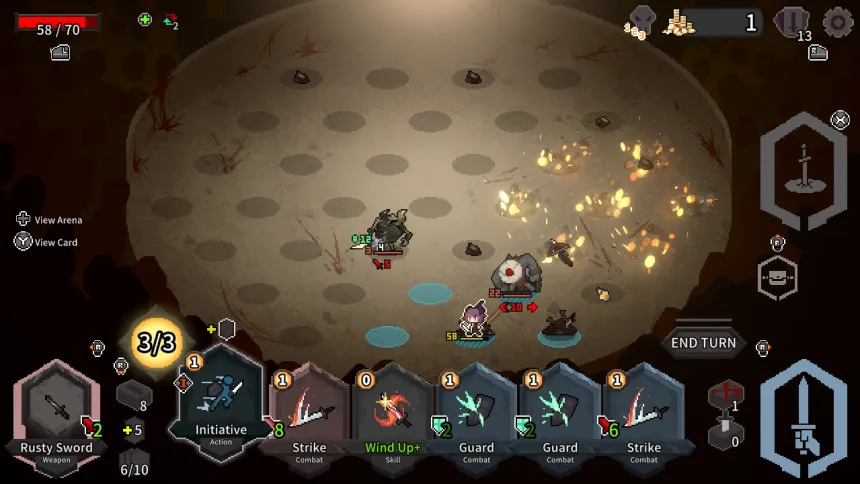
Corners and edges look safe because fewer enemies can surround you.
They can also kill you because fewer escape hexes exist.
The edge of the arena is useful when you control the push angles. It is dangerous when enemies control the approach. If you retreat to a wall without a plan, you may remove your own ability to dodge, rotate, or reposition.
A better beginner habit is to think in exits.
Before ending on any hex, ask:
- How many safe hexes can I reach next turn?
- If an enemy moves adjacent, do I still have a way out?
- Does this wall help my knockback plan, or does it trap me?
- Am I choosing this space because it is safe, or because it feels safe?
The center is not automatically good either. It can expose you to multiple lanes.
But it usually gives more correction options.
In Alina, flexibility is often better than comfort.
Facing and lanes decide whether a turn is clean
Alina rewards players who think about lanes before card rarity.
Facing is easy to undervalue because card text feels more exciting. But bad facing creates inefficient turns. If you need to spend stamina just to correct your angle before every attack, your deck will feel clunky even when the card quality is fine.
Try to end turns with your next action in mind.
If you expect an enemy to approach from a certain lane, face or position yourself so the next turn starts with options. You want your opening card next turn to be useful without needing two setup steps.
The same logic applies to lanes.
A lane is not just a line of attack. It is a path of future pressure. If you stand where two enemies can collapse from different angles, you may technically be safe this turn while creating a miserable next turn.
Clean Alina turns often come from small positional advantages:
- One enemy is blocked behind another.
- A wall limits the direction enemies can approach.
- Your facing already supports your likely next attack.
- A knockback card has a clear target and destination.
- You can attack and still end outside the main threat lane.
Those are not flashy plays.
They are how you stop bleeding health in early fights.
Your weapons decide your safe hexes
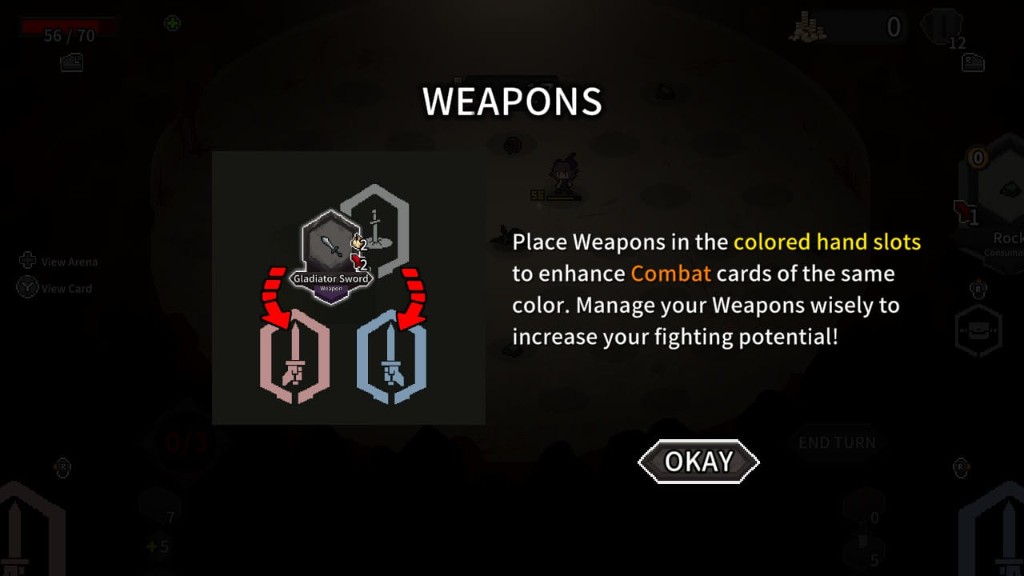
Positioning is not abstract. It depends on what you are holding.
A safe hex with one weapon can be a terrible hex with another. If your weapon needs close contact, you have to respect enemy bodies, walls, and escape routes much more carefully. If your weapon gives you more reach or a wider attack pattern, you can sometimes deal damage without stepping into the worst part of the arena.
That changes your whole turn.
Before committing to a line, ask:
- Can this weapon hit from where I want to end?
- Does attacking force me into a worse hex?
- Am I using reach to stay safe, or wasting it by standing too close?
- Does this weapon help me control space, or only add damage?
- Does my off-hand give me enough defense when movement fails?
This is also why shields matter. A shield does not replace positioning, but it gives you a better answer when the board cannot be solved cleanly. If your deck is light on movement or knockback, off-hand defense can buy the breathing room that pure damage cannot.
The trap is choosing equipment only by damage.
Higher damage is nice. But if the weapon makes every attack awkward, drains your stamina, blocks an off-hand option you needed, or forces you into bad lanes, the number is lying to you.
Beginner-friendly equipment keeps turns playable.
Greedy equipment asks the board to be perfect.
Draft cards that fix board states
Once you understand the board-first approach, drafting becomes clearer.
You are not just looking for bigger numbers. You are looking for cards that solve the situations that actually kill you.
Good beginner draft questions include:
- Does this card move me, move an enemy, or change a lane?
- Can it help when I am surrounded?
- Is the stamina cost realistic in a bad turn?
- Does it work without a perfect setup?
- Does it improve my ability to end safely?
- Am I adding too many attacks that all ask for the same position?
Damage still matters. If your deck cannot kill, fights drag on and positioning gets harder.
But pure damage is rarely the full answer.
A deck with no control asks you to win every race. Beginners usually lose those races because one bad draw or one blocked path ruins the plan.
The best early cards are often the ones that keep turns playable. Movement, knockback, flexible attacks, and efficient defensive tools are more valuable than they first appear because they reduce the number of dead board states.
Avoid drafting for fantasy turns
Many early losses come from drafting cards that are excellent only when you are already stable.
A fantasy-turn card says:
If I am standing in the right place, with enough stamina, and the enemy is lined up perfectly, this is amazing.
A beginner-friendly card says:
If the board is messy, this still helps.
That distinction is huge.
Alina is hard because the arena keeps changing. Enemies move. Lanes close. Walls cut off exits. Your hand does not always match your position. Cards that only shine in perfect conditions can make your deck look strong while making your actual turns worse.
Draft some payoff, but make sure your deck has enough glue.
Glue cards are the cards that move, push, reposition, defend, or let you take a safe partial turn instead of gambling on a perfect one.
Your first priority is reducing pressure, not maximizing damage
Beginner players often try to kill the most dangerous enemy immediately.
Sometimes that is correct.
Often, it is bait.
If killing one enemy requires you to stand in range of two others, the trade may be terrible.
Think in terms of pressure. A turn that deals modest damage and prevents two attacks is usually better than a turn that deals high damage and eats a hit for no good reason.
Pressure can be reduced by:
- Killing an enemy.
- Moving out of the attack area.
- Pushing the attacker away.
- Blocking one enemy with another.
- Moving toward a space with better future exits.
- Forcing enemies to spend time walking instead of attacking.
This is one of the most important Alina of the Arena tips: not every defensive turn is a weak turn.
Sometimes the strongest play is the one that makes the next two turns easy.
Learn when greed is actually safe
You do need to be greedy sometimes.
If you only dodge and chip away, fights can stretch long enough for mistakes to pile up. The trick is knowing when greed is supported by the board.
Greed is safer when:
- The target will die before acting.
- You have already checked your ending hex.
- Enemies are separated or blocked.
- Your remaining stamina can still fix a mistake.
- The next likely enemy movement does not trap you.
- You are using knockback or positioning as part of the damage plan.
Greed is dangerous when:
- You are spending your last stamina for a non-lethal hit.
- You are moving to an edge with no exit.
- You need the next hand to contain a specific answer.
- Multiple enemies can attack the same small area.
- Your attack improves damage but worsens facing or spacing.
Good Alina play is not passive.
It is controlled aggression.
You push damage when the board allows it, not when your hand tempts you.
A simple turn routine for beginners
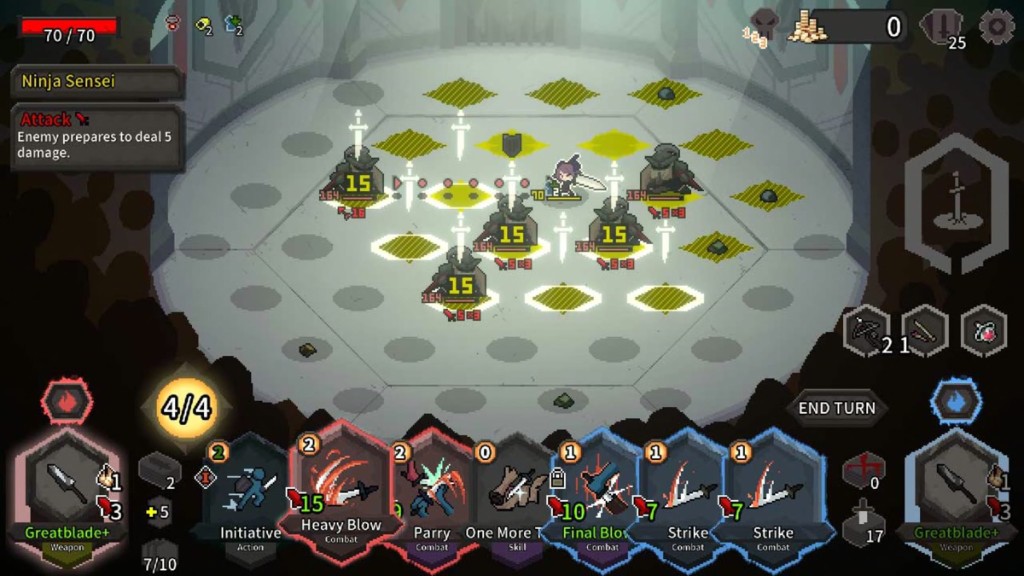
If you keep dying early, use this routine until it becomes automatic.
1. Identify every incoming hit
Do not start with your combo.
Start with survival. Count the attacks that matter.
2. Pick your desired end hex
Choose where you want to finish the turn.
If you cannot find a safe ending position, look for knockback, blocking, or enemy movement instead.
3. Check whether enemies can be moved instead
If a push cancels an attack, it may be better than spending movement on yourself.
Moving the enemy often keeps your own options open.
4. Spend stamina on the escape plan first
Do not leave survival to your final card unless you are sure the sequence works.
Damage after safety is boring.
Boring wins runs.
5. Add damage after the board is stable
Once you are safe, use the remaining stamina to kill, soften, or set up.
This keeps you from turning a good hand into a bad position.
6. Look at next turn before confirming
Ask whether your ending position has options.
A safe hex with no future exits may only delay the problem.
This is how to play Alina of the Arena more consistently. You are building a habit of sequencing around danger instead of reacting after the turn has already gone wrong.
Common beginner mistakes
Playing the hand instead of the board
A strong-looking hand can still be wrong for the current position.
If the board asks for movement, do not force an attack sequence just because the numbers look good.
Treating health as a free resource
Yes, you can take damage.
No, you should not take random damage because you want one more attack.
Health loss is most acceptable when it ends a fight, removes a major threat, or prevents worse damage later.
Using knockback only after attacks
Knockback often belongs at the start of the sequence.
Push first, break the enemy plan, then decide whether damage is still needed.
Ending turns with no stamina and no exit
This is the classic early death pattern.
The turn looks efficient. Then the next board is impossible.
If you keep dying right after a strong-looking turn, this is probably why.
Drafting too many narrow cards
Cards that require exact positioning can be powerful, but too many of them make the deck brittle.
Beginners need enough flexible tools to survive awkward draws.
Assuming walls are always defensive
Walls can protect one side, but they also remove escape routes.
Use them when they support your knockback or lane plan. Avoid them when they simply make you feel less surrounded.
What to practice in your next run
For your next few runs, do not measure improvement only by wins.
Measure whether your turns are becoming cleaner.
Focus on these goals:
- End fewer turns in corners.
- Save stamina when the board is not fully solved.
- Use knockback to prevent attacks, not just add value.
- Draft at least some cards that fix bad positions.
- Stop playing damage before identifying your safe end hex.
- Review deaths by asking, "Which position made this unavoidable?"
That last question is the real beginner breakthrough.
Most failed runs are not caused by one bad draw. They are caused by two or three turns where you slowly gave away space, stamina, and escape options.
Alina of the Arena becomes much more readable once you stop treating the deck as the whole game.
The cards are your tools.
The arena is the problem.
Solve the hexes first, and your drafts will start making a lot more sense.