7 Best Deckbuilders With Challenging Boss Fights
A ranked look at roguelike deckbuilders whose bosses test scaling, defense, positioning, party synergy, and card evaluation rather than health-bar size.
The best deckbuilder bosses are not ordinary enemies with larger health bars. They change the rules, punish narrow strategies, or expose a weakness that has been hiding in your deck for half the run.
This ranking is for players who already understand run-based deckbuilding and want the finale to test how they drafted, upgraded, and routed. It favors readable mechanics over spectacle, and fights you can prepare for over unexplained damage spikes.
The best deckbuilders with challenging boss fights at a glance
| Rank | Game | What its bosses test most | Best fit |
|---|---|---|---|
| 1 | Slay the Spire | Scaling, defense, and route discipline | Players who want drafting, routing, and combat to form one connected test |
| 2 | Monster Train | Floor setup, unit scaling, and capacity | Players who enjoy building an engine, then solving where every part belongs |
| 3 | Chrono Ark | Party roles, healing, and flexible sequencing | Players who want complex party composition and boss mechanics that must be learned |
| 4 | Wildfrost | Positioning, countdowns, and target priority | Players who want short runs, positional tactics, and turns with immediate consequences |
| 5 | Vault of the Void | Sideboarding, purging, and threat control | Players who enjoy precise preparation and reducing randomness through planning |
| 6 | Cobalt Core | Ship alignment, targeting, and crew synergy | Players who want readable enemy turns and spatial tactics without a full grid |
| 7 | Roguebook | Hero pairings, front-line order, and map exploration | Players who want hero pairings, front-and-rear tactics, and an open map |
These games are ordered by how strongly the boss fight is connected to the rest of the run. The top entries make the finale a test of decisions you made ten rooms earlier. The lower entries are still worth playing, but their bosses leave more room to recover or ask less of a complete plan.
1. Slay the Spire remains the best test of a complete deck
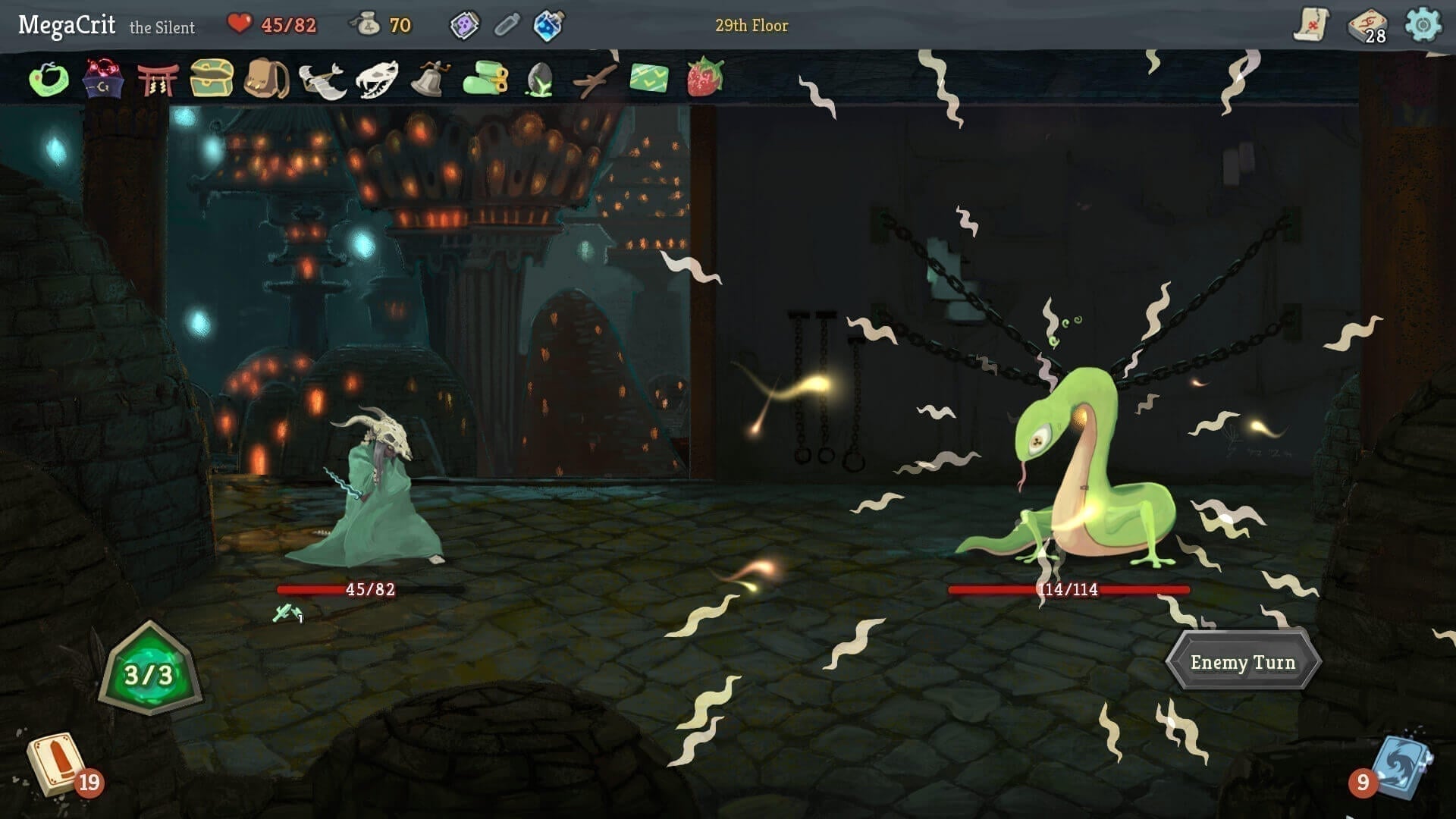
No game on this list connects the boss fight to the rest of the run as cleanly as Slay the Spire. The boss waiting at the end of each act is shown on the map, so you can draft and choose your route with that encounter in mind.
The important part is that different bosses punish different shortcuts. Time Eater's Time Warp counts cards across the fight: the 12th play ends your current turn and Time Eater gains Strength, so spam-heavy decks have to budget their cards instead of dumping a huge turn. During its first phase, Awakened One gains Strength whenever you play a Power. The Heart, the Act 4 finale after the climb, combines Beat of Death, which hurts you whenever you play a card, with Invincible, a per-turn damage cap. These are not interchangeable tests, and a deck that crushes one can struggle against another.
Its best fights ask for several things at once: enough immediate output to survive the opening turns, defense that remains useful as damage rises, and a way to scale before the enemy does. That is why a pile of individually strong cards can still fail. The deck needs a plan, not just value.
Route choices complete the design. Elites offer relics but cost health. Campfires force a choice between healing and upgrading. Shops can fix the deck, but only if you preserved enough gold. By the time the boss appears, much of the result has already been shaped by those decisions.
Best for: Players who want drafting, routing, and combat to form one connected test.
Main limitation: The presentation is restrained. These fights are memorable because of their mechanics, not because they are elaborate cinematic set pieces.
2. Monster Train makes the final wave an engineering problem
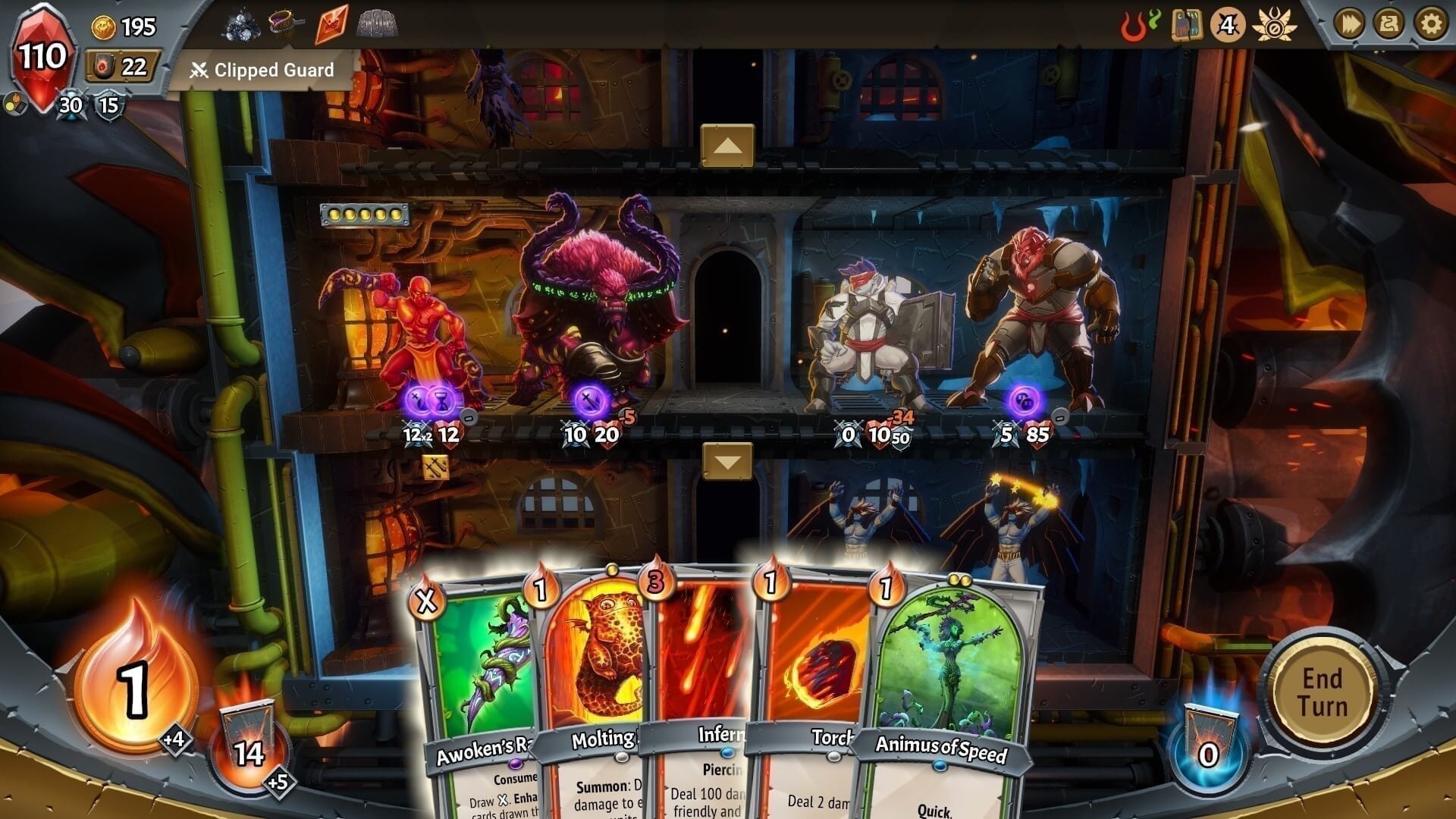
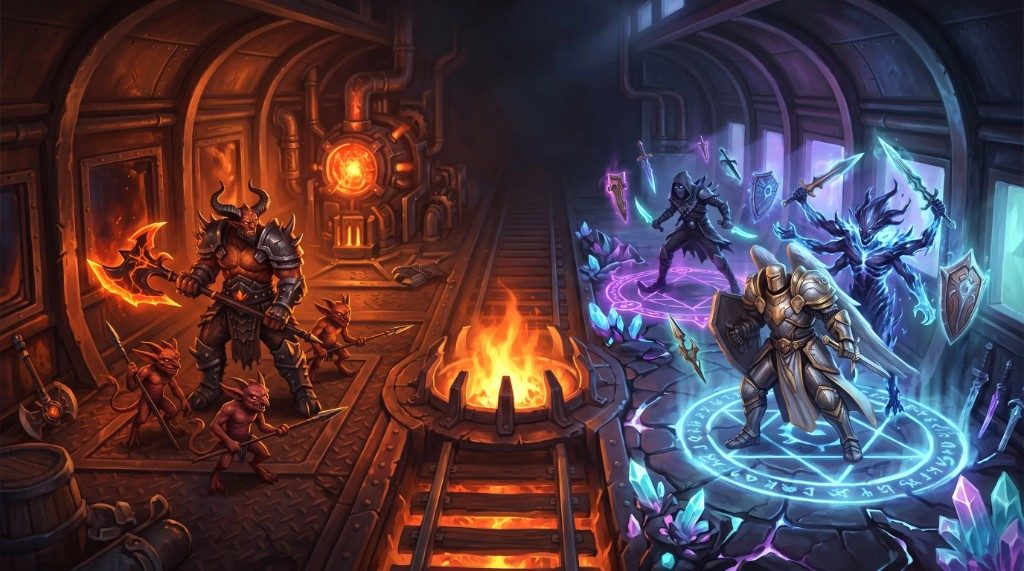
Monster Train turns boss preparation into a spatial problem. You deploy units across three combat floors, each with limited capacity, while enemy waves climb toward the Pyre above them. Spells, unit upgrades, floor capacity, and the order of your units all affect whether a setup survives.
Major bosses make this structure especially effective. Before boarding, they appear beside the train while regular waves attack and the boss applies its own pressure. Once the boss boards, Relentless combat repeats on a floor until one side is defeated. A formation that handled normal waves can collapse immediately if its front unit lacks durability or its damage scaling arrived too slowly.
Many successful runs revolve around a carry, but the game does not ask only how large that unit can become. You must fit the formation onto a floor, protect fragile support units, clear dangerous back-line enemies, and stop leaks from reaching the Pyre. Some builds concentrate everything on one floor; others spread control and damage across the train. Both approaches can work, but both need a clear answer for the final wave.
Best for: Players who enjoy building an engine and then solving where every part of it belongs.
Main limitation: Monster Train allows extremely powerful combinations. When a scaling loop is solved early, the boss may become confirmation that the engine works rather than a tense turn-by-turn duel.
3. Chrono Ark pressures the whole party, not one combo
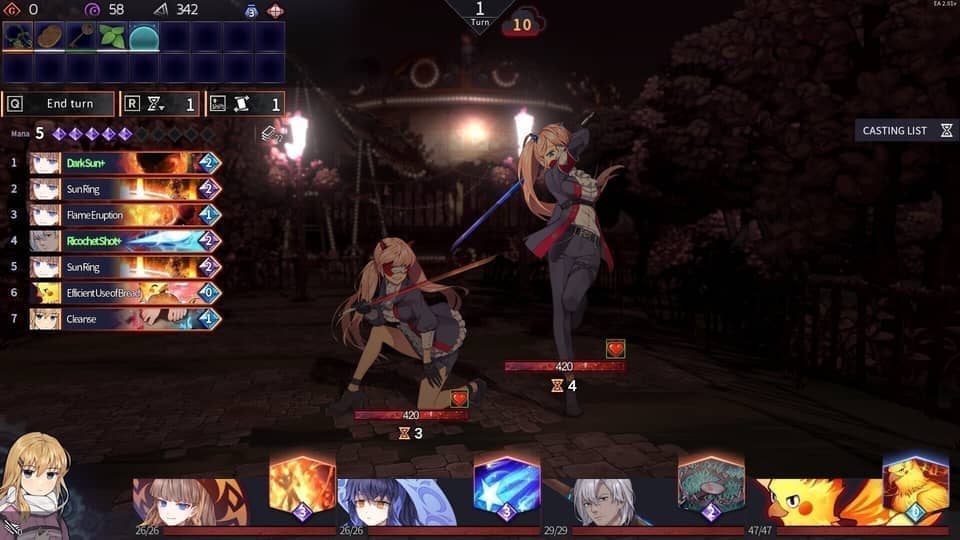
Chrono Ark mixes roguelike deckbuilding with a party-based RPG. Instead of developing one character in isolation, you recruit investigators with distinct skills and combine their cards into a shared battle plan.
That gives its bosses more ways to disrupt you. A party must deal damage, manage healing, protect vulnerable members, and keep functioning when debuffs or encounter-specific cards interfere with the preferred sequence. Some fights behave more like mechanical puzzles than simple races, rewarding players who understand the boss instead of relying on one universal combo.
The key test is role coverage. A highly specialized damage dealer may look unstoppable until the party loses its healer or cannot remove a harmful effect. A slower team may survive comfortably but fail to finish before the encounter becomes overwhelming. Strong runs give each investigator a job while leaving enough overlap to recover when the ideal order breaks.
Best for: Players who want complex party composition and boss mechanics that must be learned.
Main limitation: There is a lot to read. Shared resources, healing rules, speed, fixed skills, character interactions, and unique boss effects make the early hours harder to parse than a cleaner single-character deckbuilder.
4. Wildfrost makes timing and position impossible to ignore
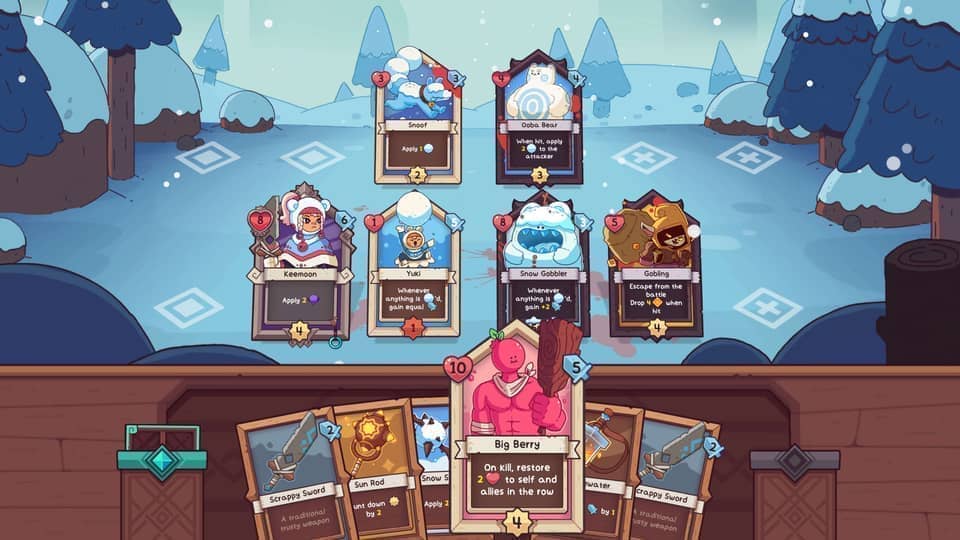
In Wildfrost, companions and enemies sit on a two-row battlefield and attack when their countdown counters reach zero. Units can be moved between positions without spending your card play, so rearranging the board is a central part of every turn rather than a minor bonus.
Bosses exploit that system well. You must track which unit will act next, who will take the hit, whether a Smackback or Teeth effect punishes an attack, and how the formation will look after the countdown advances. Bosses can also transform into a second phase, turning an apparently safe board into a new targeting problem.
This creates a different kind of build check from Slay the Spire. A strong card is not automatically a safe play. Adding a companion can occupy the wrong position, triggering an attack at the wrong time can be fatal, and a unit that carried the early run may become dangerous against a specific counter. Success depends on reading the whole board several actions ahead.
Best for: Players who want short runs, positional tactics, and turns with immediate consequences.
Main limitation: Wildfrost can feel harsh before its visual language becomes familiar. Some players also dislike how sharply certain enemy effects counter a successful strategy, so not every loss feels as flexible as the best fights in Slay the Spire.
5. Vault of the Void gives you the tools to prepare precisely
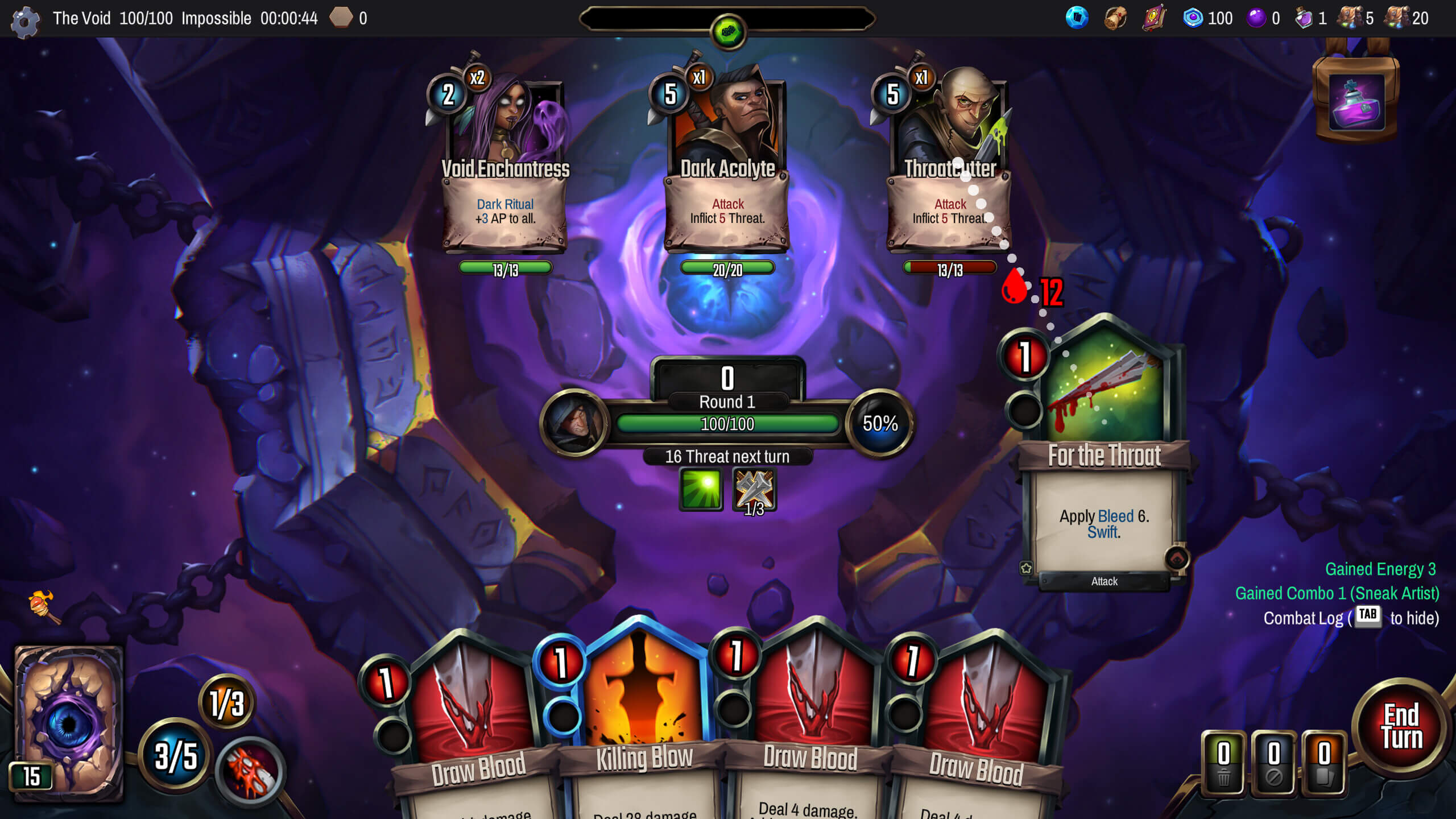
Vault of the Void earns its place through control. Your active deck must contain exactly 20 cards, but collected cards stay in a backpack and can be swapped before each battle. The game also shows which enemies are ahead, letting you adjust the deck for a known problem instead of hoping to draw a late answer.
Combat adds two systems that make this preparation matter. Any card in hand can be Purged for energy, forcing a choice between its printed effect and the resources needed to play something else. Enemy attacks first add Threat, which you can reduce with Block before the remaining amount becomes health damage. Defense is therefore reactive rather than a prediction made before the enemy acts.
Against bosses, the challenge is consistency and adaptation. You can add the exact defensive or scaling tool the encounter needs, but every inclusion removes another card from the fixed list. A failed fight often points to a specific mistake: the wrong sideboard choice, a poor Purge, or a deck that cannot turn its strong cards into a repeatable sequence.
Best for: Players who enjoy sideboarding, precise hand management, and reducing randomness through planning.
Main limitation: All that control creates upkeep. Constantly swapping cards, socketing Void Stones, and reviewing known rewards can feel more like technical tuning than the improvisation some players want from a roguelike.
6. Cobalt Core turns defense into movement and alignment
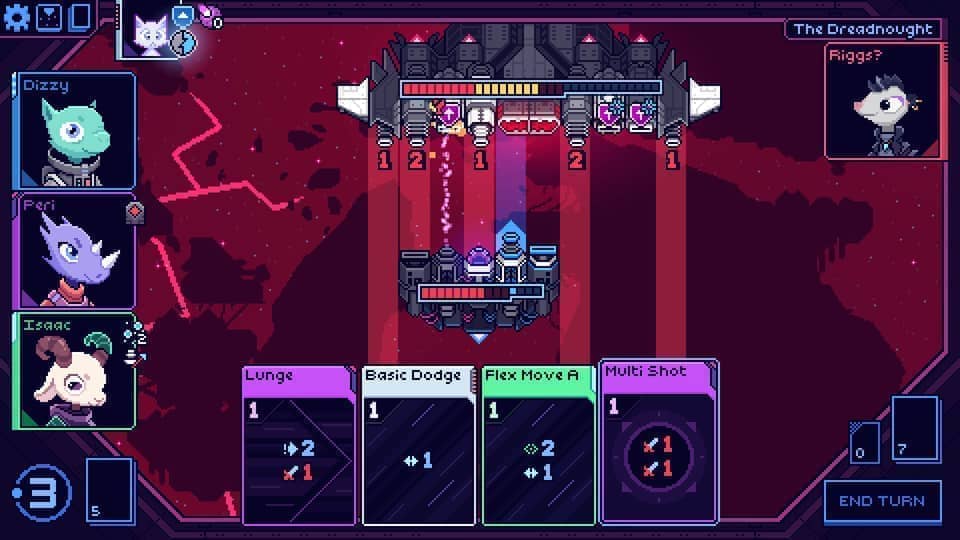
Cobalt Core places two ships on a single horizontal axis. Attacks fire from specific parts of your ship, so you must line up weapons with vulnerable enemy sections while moving your own important parts out of danger. Missiles, drones, shields, evade, and visible enemy intents make positioning part of the card game.
Your deck is built from the three crew members chosen for the run, each contributing a different card pool. That makes synergy important, but the bosses also punish plans that do only one thing. A movement-heavy deck still needs damage. A drone build needs an answer when objects are destroyed or displaced. Heavy shielding helps only if the enemy cannot bypass it or scale faster.
The strongest encounters ask you to solve offense and defense with the same movement. Shifting one space may dodge a cannon but ruin your own firing line; attacking the correct ship part can disable a dangerous action instead of merely reducing health.
Best for: Players who want readable enemy turns and spatial tactics without a full grid.
Main limitation: Normal difficulty is fairly approachable, and several players find the overall boss pool easier and less varied than Slay the Spire's. Choose one of the higher difficulty settings if demanding bosses are the main reason you are playing.
7. Roguebook offers flexible preparation and two-hero recovery
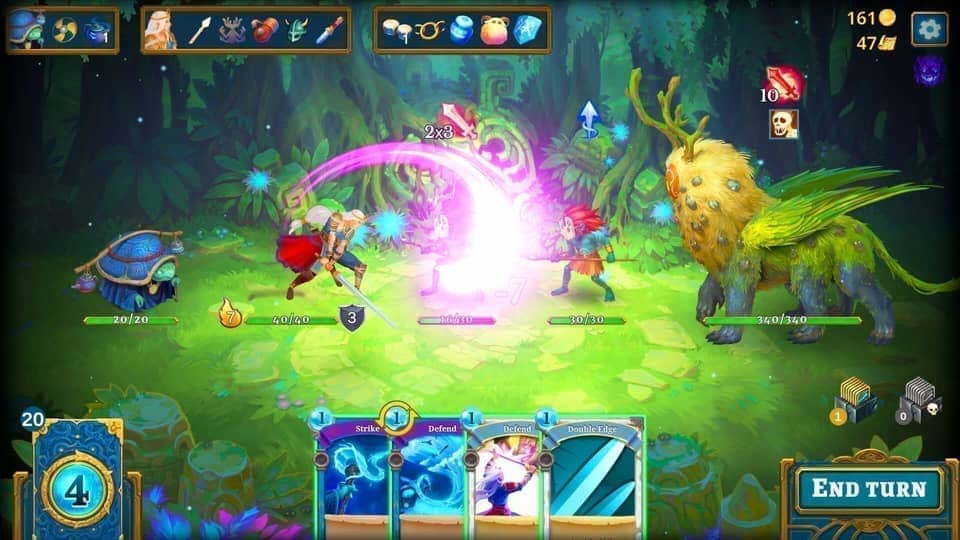
Roguebook combines the decks of two heroes. Their front and rear positions matter in combat: the front hero usually receives attacks, while many cards move or benefit a hero based on position. A good pair can divide offense, defense, and support duties, then swap roles when one hero is under pressure.
Its hex grid belongs to the exploration map, not the battle screen. Ink and brushes reveal tiles containing fights, shops, treasures, and other rewards. Because the boss can be approached before the whole map is uncovered, the practical question is when to stop spending resources on exploration and commit to the fight.
Roguebook also pushes against the usual advice to keep a deck tiny. Adding cards unlocks run-specific talents at deck-size thresholds, so preparation is about balancing a larger pool of options against draw consistency. Bosses test whether the two heroes support each other or merely contribute unrelated strong cards.
Best for: Players who want hero pairings, front-and-rear tactics, and an open map they can explore at their own pace.
Main limitation: It is the softest fit for this list. Difficulty rises through Epilogues, but the base game gives powerful builds plenty of room to recover, and some players find its later bosses less tense than its early encounters.
Which one should you play?
Choose Slay the Spire for the strongest overall connection between drafting, routing, and boss survival. Choose Monster Train if you prefer building a powerful formation across multiple floors. Pick Chrono Ark for party management or Wildfrost for compact positional puzzles.
Vault of the Void is the best choice when you want maximum control over preparation. Cobalt Core offers the most approachable spatial combat, while Roguebook gives you the most freedom to explore and experiment with hero pairings.
The games differ, but the good encounters share one quality: defeat teaches you something specific. You learn that your scaling started too late, your defense depended on one draw, your formation had no safe position, or two individually strong card packages never became a real plan. That is what makes a boss more than a large health bar, and what makes the next run hard to resist.