Griftlands vs Black Book: Which Story Deckbuilder Wins?
Griftlands turns talking into a second deck. Black Book turns a Slavic folklore campaign into a grimoire. Here is which story deckbuilder actually fits you.
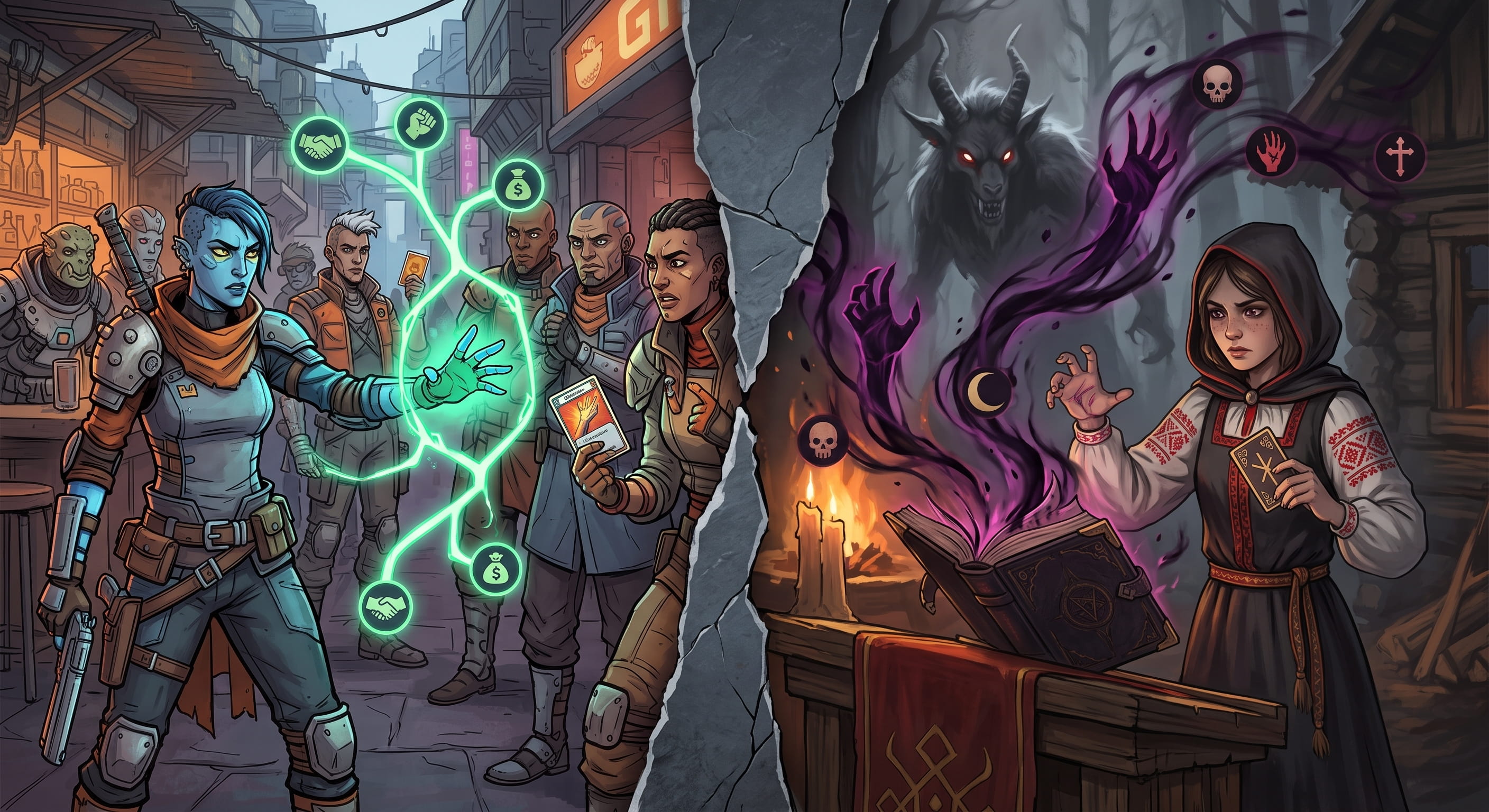
Griftlands vs Black Book is not a close-systems comparison. Both are story-first deckbuilders, but they solve different problems.
Griftlands makes conversation a second battleground. You keep a combat deck and a negotiation deck, and a lot of the story is asking which one you are willing to use. Black Book is a folklore RPG that happens to fight with cards. You play Vasilisa, a village knower in 19th-century Russia, binding pages into a book and assembling spells to break seven seals.
If you want branching jobs, talk-or-fight pressure, and campaigns you can restart, pick Griftlands. If you want one dark adventure where the setting does most of the work, pick Black Book.
Quick verdict
| Category | Better fit |
|---|---|
| Talking as a real card game | Griftlands |
| Two decks to build at once | Griftlands |
| Ritual, ordered spell construction | Black Book |
| Dark folklore atmosphere | Black Book |
| Replayable character campaigns | Griftlands |
| One sustained story | Black Book |
| Faster to learn and restart | Griftlands |
| Setting that changes how cards feel | Black Book |
Choose Griftlands if you want narrative choices to become deck problems. Negotiating is not a dialogue minigame. It has its own cards, its own health, and its own way to lose.
Choose Black Book if you want the world more than the run. The combat is unusual, but the reason to stay is the folklore, the village work, and a campaign that wants a long session rather than another restart.
Talking is the whole point of Griftlands
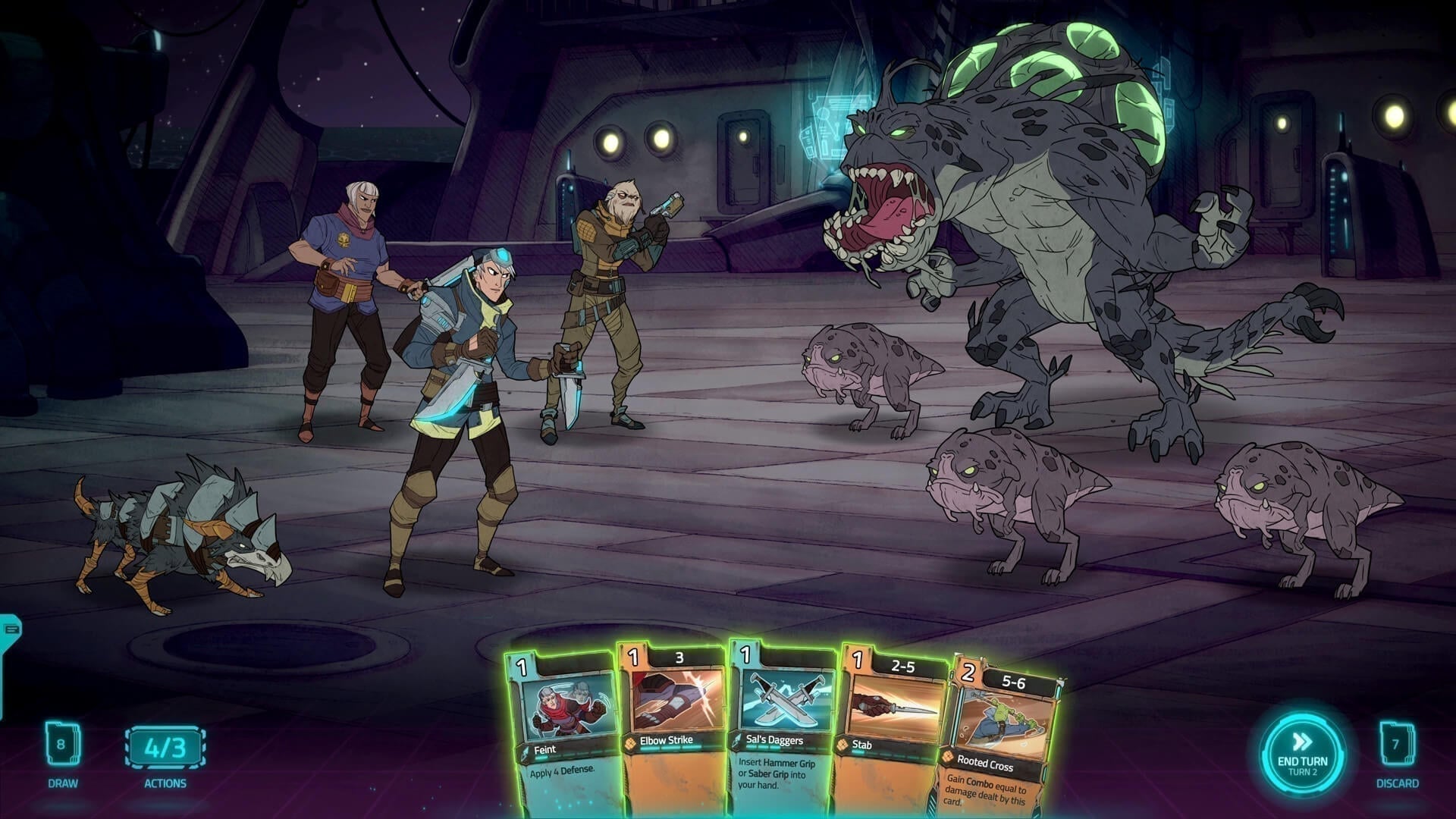
Most story deckbuilders still resolve conflict with a fight. Griftlands does not. A job, a threat, or a boss setup can often be talked through instead, and that talk uses a completely separate deck.
Negotiation is a card battle dressed as an argument. You attack a core argument, protect your own resolve, and play supporting arguments onto the field like units. Composure is the defense layer. The vocabulary is social, but the decisions are tactical: what to threaten, what to defend, and when to stop before you burn the resolve you need later.
That split is the game. Combat and negotiation do not share cards. A graft or reward that saves a fight does nothing for a shakedown. Specialize in talking and the story opens up, until an unavoidable battle exposes a neglected combat deck. Specialize in fighting and you start losing people you could have convinced.
The campaigns are short by RPG standards and long by roguelike standards. Sal, Rook, and Smith each get a story of about four or five in-game days. Jobs, side opportunities, and faction choices shuffle around a fixed spine, and death sends you back to the start of that character. A campaign is a few hours, not a twenty-minute climb.
The characters also change the card language. Sal stacks Influence or Dominance depending on whether she is diplomatic or hostile. Rook flips a coin that rewrites his cards, and can cheat it. Smith drinks, generates Fame, and plays like a disaster you are trying to point at someone else. That is more build identity than “story deckbuilder with extra dialogue.”
The cost is overhead. You are maintaining two decks, reading two kinds of encounter, and tracking health and resolve between jobs. Players who wanted a clean battle engine sometimes bounce off negotiations. Players who wanted talking to matter usually stay for exactly that friction.
Black Book treats the deck like a grimoire
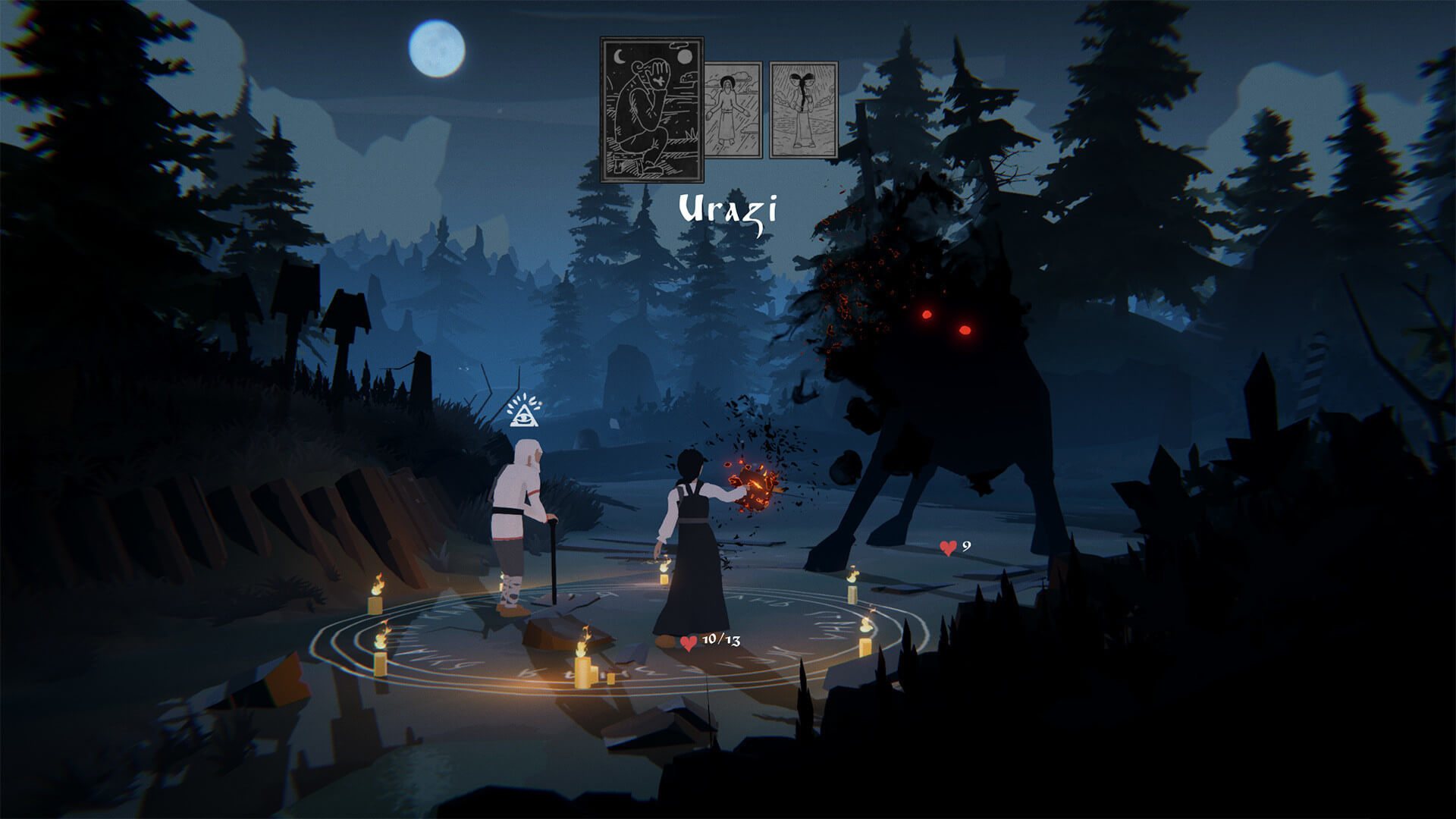
Black Book is not trying to be a dual-system puzzle. You play one campaign as Vasilisa. Her fiancé is dead, buried outside consecrated ground, and the Black Book will grant a wish if she can break its seven seals. Between those seals she works as the local knower: peasants bring problems, demons occupy mills and bathhouses, and knowing the right folklore is often as useful as winning a fight.
Combat is the distinctive part people undersell. You bind pages into a book, then assemble a zagovor — a spell — from the cards in your hand. Order matters. Buffs want to sit at the front of the phrase. Black pages are offensive, white pages are defensive, and a key card seals the spell before it fires. You line the whole thing up, then cast it. It feels closer to writing a ritual than to playing a poker hand or a Slay the Spire turn.
That is why calling Black Book a “traditional card RPG” misses it. The campaign structure is traditional. The verb is not. The limitation is volume. Over a long adventure the same spell grammar repeats, and fights can start to feel similar once you have a functional book. The pleasure is refining one occult toolkit while the story moves, not drafting a new identity every night.
The adventure layer does work the cards cannot. Some encounters are riddles. Some demons can be handled with the right knowledge or companion instead of a duel. A stretch of the game even drops card combat to play detective. That is the opposite of Griftlands’ “every conversation is a deck check.” Black Book keeps asking whether you understand the world, not only whether your pages are efficient.
Which game is actually the deeper deckbuilder?
Griftlands has more deckbuilding to do. Two decks, three heroes, grafts, and a talk-or-fight resource split create more places for a reward to be right or wrong. You are constantly asking which deck is starving, which encounter type is coming, and whether a tempting card solves the problem in front of you or the one you have been ignoring.
Black Book has the stranger combat idea. Arranging a zagovor is a sequencing puzzle Griftlands never asks. There is a real satisfaction in getting the phrase right: defense first, payoff last, keys in the right seat. It just does not multiply across a second system or three campaigns.
So the honest split is:
- Griftlands is deeper as a deckbuilding game: more builds, more failure states, more reasons to restart.
- Black Book is more distinctive as a combat language: one ritual system that belongs to its fiction.
If “depth” means how many ways a run can go wrong, Griftlands wins. If it means whether the cards feel like something other than generic attacks, Black Book has a stronger case than its reputation as a mood piece suggests.
Campaigns versus one long folklore story
Neither game is Slay the Spire. The pace difference is still large.
Griftlands is episodic. A day is jobs, a limited-time opportunity, maybe a negotiation you should not have started, and a boss that you may have softened up by talking first. Failure is readable. You can see that resolve was too low, the combat deck was thin, or you backed the wrong faction. Then you start that character again, or switch to another.
Black Book is a campaign you inhabit. You return to the house, hear villagers, travel, fight or bargain, and break the next seal. Progression is character and lore as much as pages. A bad fight is a setback inside a longer story, not a prompt to queue another run. That is why it feels slower, and why judging it by restart speed is the wrong test.
Replay follows the same line. Griftlands wants another campaign with a different hero, a different faction lean, or a negotiation-first build you refused last time. Black Book wants you to finish the tale, then maybe return for other choices and endings. It will not feed a “one more run” habit. It is not built for one.
Atmosphere is not decoration here
Griftlands is a dirty sci-fi colony full of people with angles. The tone is sarcastic, mercenary, and character-driven. That is why negotiation belongs in the rules. Social pressure is the setting, so it would be strange if talking were only flavor text.
It is not a light or playful game. It is colorful and funny in a cynical way. The cards feel like tools for getting paid, getting even, or getting out.
Black Book is heavier. Rural Russia at the end of the 19th century, old beliefs still working, Orthodox taboos in the background, demons treated as a practical nuisance until they are not. The encyclopedia is not trivia. Naming a spirit correctly is gameplay. That weight makes even a familiar damage-and-ward pattern feel like a rite instead of a puzzle.
If you want the setting to make you patient, Black Book wins. If you want the setting to make every conversation dangerous, Griftlands wins.
Griftlands or Black Book: which should you play?
Pick Griftlands if you want:
- A second deck devoted to arguments, threats, and deals
- Story choices that starve one deck while feeding the other
- Three character campaigns you can fail and replay
- Sci-fi faction pressure instead of myth
- More total deckbuilding, even if combat itself is more conventional
Pick Black Book if you want:
- A Slavic folklore RPG with card combat, not a card game with lore pasted on
- Spell assembly where card order is the ritual
- Village knower work, demons, riddles, and seven seals as the campaign spine
- One long dark story rather than restartable runs
- Atmosphere that makes you slow down on purpose
Final verdict
Griftlands is the better deckbuilder. Two decks and three campaigns give it more decisions per hour, and talking is not a sidebar. It is the one to play if you care that narrative choices change the cards in your hand.
Black Book is the better story adventure. Its combat is more unusual than people give it credit for, but the reason it sticks is the folklore campaign around those fights. Stay with it for Vasilisa’s world. Do not come to it looking for Griftlands’ restart loop.
Play Griftlands when you want to improvise through social pressure. Play Black Book when you want to sit with a grimoire and a legend until the last seal breaks.