How Deck Thinning Works in Deckbuilding Games
Why removing weak cards matters, when thinning is worth it, and when players can take the idea too far.
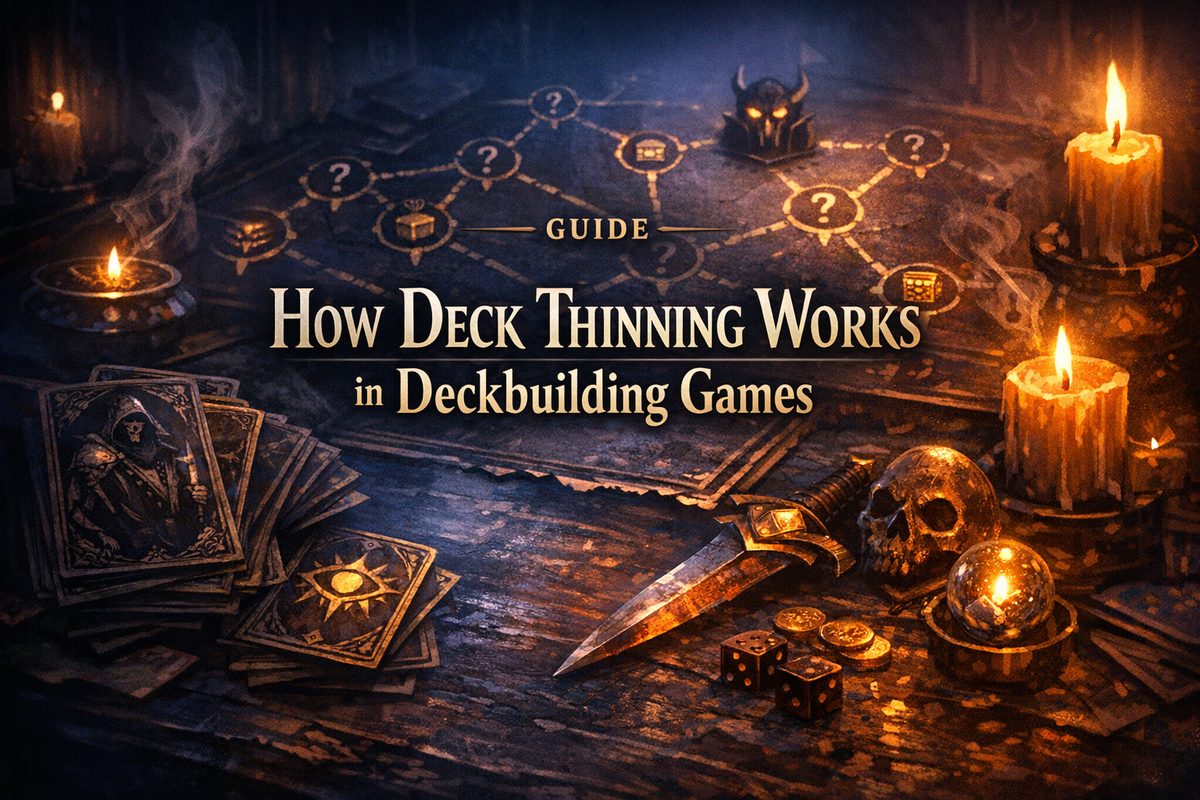
Deck thinning is the promise of cleaner draws, tighter combos, and fewer dead turns. In deckbuilding games, that sounds obviously correct. It often is. It also gets repeated so often that players start treating it like a rule instead of a tool.
This is for players who already understand why Strikes, starter cards, and low-impact fillers become a problem, but want to know when cutting cards actually changes a run. The angle here is simple: thinning matters because it changes what you draw and when you draw it, but consistency vs power is a real tradeoff, not a slogan.
What deck thinning actually does
At the simplest level, deck thinning means removing low-value cards so your best cards show up more often. That part is true, but it is still too vague to be useful.
What matters is not just "smaller deck good." What matters is how often your deck reaches its important cards, how reliably your turns line up, and whether your current list solves the fights in front of you.
A trimmed deck usually helps in three ways:
- You see core cards more often.
- Your strong hands appear earlier in a cycle.
- Your synergies stop getting interrupted by weak filler.
That is why card removal feels so powerful in games like Slay the Spire or Monster Train. A dead starter attack is not just weak on its own. It also replaces a draw that could have been block, scaling, energy, or payoff.
The key mechanic is opportunity cost inside the draw pile. Every weak card is a slot that delays something better.
Why thinning changes the run, not just the deck
The important question is not "is this card bad?" The important question is "what does removing it let me do sooner or more reliably?"
That difference matters because draw order and deck size interact in non-obvious ways. If your deck has one crucial setup card and one payoff card, cutting two junk cards does more than raise average quality. It makes it more likely those pieces meet in the same fight window, before you take too much damage or miss your kill turn.
This is where thinning becomes a run-shaping mechanic instead of a cleanup habit.
A few common examples:
- Removing basic attacks can make defensive engines online faster.
- Cutting weak blocks can improve aggressive decks that need to race.
- Deleting status-prone filler can make draw and discard loops much cleaner.
- Trimming a bloated deck can reduce the number of turns spent "finding" your scaling.
That last point gets overlooked. Many players talk about deck quality in abstract terms. In practice, the run is often decided by timing. If your scaling card arrives on turn 2 instead of turn 5, the fight can look completely different.
Thin decks are good until they stop solving your actual problem
This is the part that gets lost in most deck-thinning advice.
A thinner deck is more consistent, but consistency is only valuable if what you are consistently drawing is enough to win. New players often overlearn the idea and start cutting toward elegance instead of toward survival.
Say your deck is compact and reliable, but your damage ceiling is too low for elites or bosses. Drawing the same decent cards every cycle does not fix that. It just makes you consistently underpowered.
The same problem shows up in reverse. Some decks need enough pieces in circulation to support scaling, exhaust payoffs, discard value, or multi-card engines. If you remove too aggressively, you can end up with a deck that is tidy on paper but awkward in actual combat.
Thin decks are good until they stop solving your actual problem.
That is why "remove your starters" is not a universal answer. Sometimes the correct play is to add a higher-impact card first, then thin later. Sometimes one extra premium card improves the run more than one removal does. And sometimes the right call is keeping an unimpressive card because it covers a specific weakness, like early block, AoE, or energy smoothing.
Consistency vs power is the real tradeoff
Players often frame deck thinning as pure upside. It is not. The tension is usually between making your deck more reliable and increasing its overall ceiling.
A removal improves average hand quality. A strong pickup might raise your best turns more, even if it makes the deck slightly less consistent. The correct choice depends on what your run is missing.
Here is a practical way to think about it:
Thin when your deck already has enough good stuff
If you have clear winners in your list—strong scaling, efficient defense, premium draw, or a defined combo line—thinning is often excellent. You are making your deck reach its working parts more often.
Add power when your deck lacks a win condition
If your deck feels clean but fights still drag, removal may be overrated. You might not need a smaller deck. You might need a card that actually changes the damage race, stabilizes your defense, or scales into longer encounters.
Respect fight length
In short fights, consistency can be everything. In longer fights, raw scaling often matters more. A perfectly trimmed deck that cannot outgrow the enemy still loses.
This is one of the better judgment calls players can make mid-run: stop asking whether thinning is efficient, and ask whether it improves your next few important fights.
Deck size matters, but not in a simple way
Many players reduce the whole topic to "small deck better." That is too crude.
Deck size matters because it affects cycle time, repeat access, and how often your best cards reappear. But a larger deck can still be stronger if the extra cards meaningfully improve your answers or broaden your engine.
Draw order is where this gets tricky.
A very small deck can let you replay your premium cards quickly. That is great if those cards cover all major needs. It is less great if you keep redrawing the same partial package while missing one crucial answer. On the other side, a bigger deck lowers repeat frequency, but can support more specialized tools without collapsing into one-note turns.
This is why draw order and deck size interact in non-obvious ways. The question is not just how many cards you have. It is:
- How many cards do you draw per turn?
- How quickly do you cycle the full deck?
- Which cards must appear early?
- Which cards are fine arriving later?
- How often do you need to redraw your best effects?
In games with lots of card draw, discard, scry, tutoring, or retain, thinning can be slightly less urgent because those systems already improve access. In games with slower draw and fewer manipulation tools, each dead card hurts more.
A small but important point: deck size can also protect you from over-reliance. If your whole plan falls apart when one card is buried, your deck may be too narrow, not too large.
When card removal is overrated
Card removal tends to be strongest when the cards you cut are genuinely weak and your deck already has direction. It gets overrated when players assume every low-impact card is equally bad in every run.
Some cases where thinning is less impressive:
Your starter cards still do a job
A basic block may still matter if your defense count is low. A weak attack may still be necessary if your damage density is shaky. Not every starter is dead weight at the same point in a run.
The game rewards volume or sacrifice
Some systems care about exhausting cards, discarding cards, playing many cheap cards, or feeding other effects. In those decks, filler can become fuel. That does not make bad cards good, but it does change their value.
You already have strong deck manipulation
If you can consistently filter, draw deep, or tutor for key pieces, the marginal value of one extra removal can drop. Access matters more than raw size.
You need broader answers
Bosses, elites, and event fights often punish decks that are too streamlined around one pattern. A narrow list can cruise regular fights and then fold when the matchup changes.
For many players, this is the main friction: they thin toward smooth normal turns, then lose because they cut too much utility. Clean hands feel good. That is not the same as being prepared.
A practical way to judge each removal
When a shop, reward, or event offers removal, run through a short checklist.
What card am I cutting, exactly?
Do not just say "a bad card." Name the role. Is it weak damage, weak block, setup that no longer scales, or a duplicate effect you do not need?
What stronger draw does this unlock more often?
Think in replacements. If this cut turns more draws into energy, scaling, draw, or your main payoff, it is doing real work.
Does my deck still cover the basics?
You still need enough damage, enough defense, and enough setup for the fights ahead. A thinner deck that misses one of those pillars is not fixed.
Am I improving consistency or avoiding a bigger problem?
This is the big one. Sometimes removal is the best option. Sometimes it is just the easiest option. Players often buy a clean-up when they really need better scaling, burst damage, AoE, or sustain.
How soon does this matter?
A removal is usually strongest when it improves your next critical fights immediately. If the gain is abstract and the run needs concrete help now, take the direct power.
That approach is less flashy than "always thin," but it leads to better decisions. The mechanic matters because it changes the run, not just because the deck looks neater afterward.
FAQ
Is deck thinning always good in deckbuilding games?
No. It is usually good when you are removing genuinely weak cards and your deck already has strong pieces worth drawing more often. It is less valuable when your deck still lacks damage, defense, or scaling.
What cards should I remove first?
Usually the weakest starter attacks or blocks, but only after checking what your deck still needs. Remove the cards that most often create dead turns. Do not cut a basic defense card just because it is boring if your deck is already light on survivability.
Can a deck be too thin?
Yes. You can end up too narrow, too dependent on one card, or too light on answers for different fight types. A tiny deck is not automatically a strong deck.
Does card draw make thinning less important?
Often, yes. Good draw, filtering, scry, discard, or tutoring can reduce the need for aggressive thinning because they already improve access to key cards. That said, draw engines get better when they are not pulling junk.
Why does my thin deck still feel weak?
Because consistency is not the same as power. If the cards you are drawing more often do not scale well, solve hard fights, or produce enough damage or defense, the deck will feel smooth but still underperform.
Takeaway
Deck thinning works because it improves access, timing, and synergy density. It gets overrated when players use it as a shortcut instead of a diagnosis. Cut weak cards when doing so helps your deck reach its real answers faster. Do not confuse a smaller deck with a solved run.