What Makes a Good Starting Deckbuilder?
The qualities that make a deckbuilder welcoming without making it shallow, punishing, or boring after a few runs.
A good starting deckbuilder should make smart runs feel possible right away, not bury the fun under jargon, dead turns, or walls of systems. New players usually want the same thing veterans do: clean decisions, satisfying synergies, and enough room to improve without feeling lost on run two.
This is a practical look at what actually makes a deckbuilder beginner-friendly without sanding off its depth. We’re focusing on the traits that keep players past the first few runs, not just the first hour, so this is for both new players and anyone trying to recommend a first game to a friend.
Readable Systems Beat Big Feature Lists
The best starting deckbuilders explain themselves through play. You can look at a card, look at the board, and make a reasonable guess about what happens next. That sounds basic, but it is the line between “I want one more run” and “I should probably watch a guide first.”
Readable systems matter more than feature count for beginners. A game does not become better for a new player because it has five resource types, three progression layers, and twenty keywords. It becomes better when cause and effect are easy to see.
That usually means a few things:
- Cards do what they say in plain terms
- Enemy intent is visible or at least learnable
- Damage, block, energy, and scaling are not hidden behind too many exceptions
- The game shows why a turn worked or failed
Slay the Spire is still a useful example here. Its systems are not simple in the long run, but they are legible early. You can understand attack, defense, draw, and scaling fast. The depth arrives through card interactions, pathing, and deck discipline rather than rule overload.
A Good First Game Teaches Without Feeling Like a Tutorial
Onboarding is not just tooltips. Good deckbuilders teach through low-stakes decisions, early feedback, and clear patterns. The player learns because the game gives them room to notice what matters.
The strongest starting games tend to introduce lessons in a smart order:
- Survive basic fights
- Understand why deck size matters
- Notice synergy and scaling
- Learn when to skip, remove, or pivot
- Handle harder encounters without rewriting the whole ruleset
That last part matters. A lot of games are easy to start and hard to stay with because the middle game suddenly expects system mastery the tutorial never prepared you for. That is not depth. It is a handoff problem.
For many players, the best teaching happens when a run clearly answers small questions. Why was this hand awkward? Why did this elite fight go badly? Why did adding “good cards” make the deck worse? A good first deckbuilder keeps those answers visible enough that players can improve naturally.
Forgiveness Matters More Than Most Genres Admit
A beginner-friendly deckbuilder should let players recover from small mistakes. Not every early bad purchase should poison the whole run. Not every weak turn should spiral into a loss. Forgiveness and depth can coexist in the right design.
This can show up in a few different ways:
- Deck thinning or card removal is available often enough to fix clutter
- Healing, shields, or safe route choices create breathing room
- Strong commons or basic upgrades keep weaker runs functional
- Early relics, items, or passives can stabilize an uncertain build
That does not mean the game should be easy. It means the punishment curve should make sense. New players often need to learn one lesson at a time. If a game punishes drafting mistakes, combat sequencing mistakes, map mistakes, and economy mistakes all at once, most of the learning gets lost in the noise.
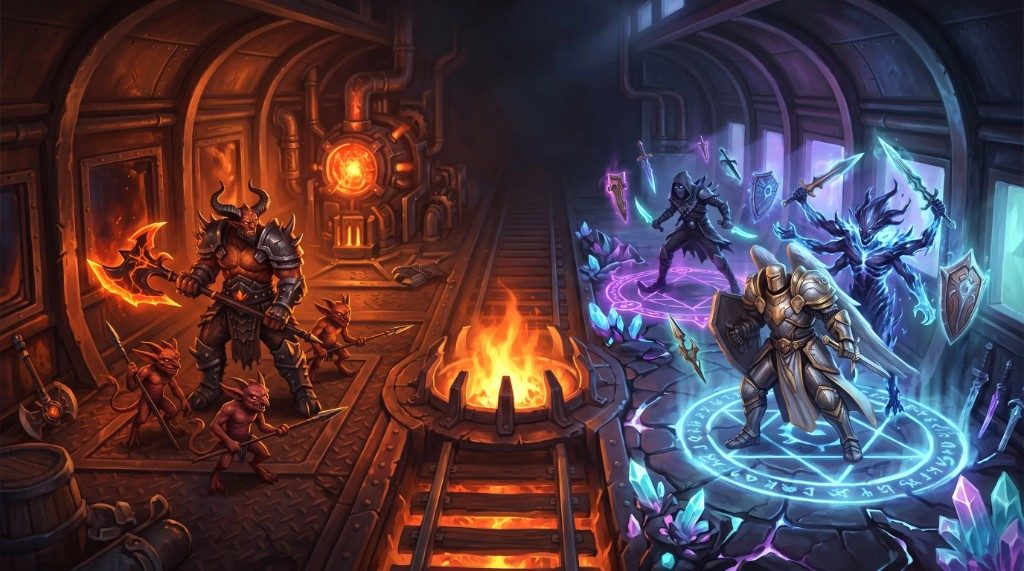
Monster Train is a good case study. It can produce explosive, clearly readable power spikes, and many runs feel salvageable even after imperfect early choices. The tradeoff is that some of its layered board management is busier than what absolute beginners may want on their first attempt. Still, its recovery tools are part of why it works for so many players after the initial learning phase.
Early Synergies Should Be Easy to Spot
A good starter deckbuilder gives players satisfying combinations early, before they know all the advanced lines. This is one of the biggest retention points in the genre. If the first few runs never produce a build that feels coherent, players bounce.
The important part is not raw power. It is visibility.
New players should be able to notice things like:
- “This card gets better when I draw more”
- “This status effect wants repeat hits”
- “This relic rewards a smaller deck”
- “This unit or card package wants me to commit to one lane or damage type”
That kind of synergy teaches deckbuilding naturally. Players stop thinking in terms of single strong cards and start thinking in packages, density, and support pieces.
A weaker starting game often hides its best synergies behind rare unlocks, dense keyword stacks, or build paths that only click once you already know the meta. The player may technically have options, but they do not feel available. That is a design miss for onboarding.
This is one reason highly readable games age well. They let beginners assemble “good enough” combos quickly, while still leaving room for sharper players to optimize draft discipline and route planning later.
Runs Need Momentum, Not Bloat
Pacing is part of accessibility. A starting deckbuilder should get to meaningful decisions quickly and avoid turns that feel like busywork. Players are much more willing to learn a system when each run has momentum.
That usually means:
- Combat resolves at a brisk pace
- Card rewards are frequent enough to shape a deck early
- Shop and event choices feel relevant without dragging
- The run structure is clear enough that players understand where they are headed
Overlong slogs are especially rough for beginners because weak decisions keep echoing for too long. A bloated run can turn one early misunderstanding into forty minutes of attrition. Fast, clean runs make experimentation safer. You can try a weird card, lose, and queue again without feeling punished by the clock.
This is where some otherwise strong deckbuilders lose new players. The systems may be good, but the pacing asks for too much patience before the build starts to sing. For a first game, shorter feedback loops are usually better than grander structure.
Depth Should Come From Better Judgment, Not Better Memory
The best starting deckbuilders stay interesting because mastery is about judgment. You improve by reading fights better, drafting tighter, and knowing when not to take a tempting card. You should not need to memorize a huge pile of hidden interactions before the game becomes rewarding.
This is the difference between approachable depth and front-loaded friction.
Good depth asks questions like:
- Is this card strong enough for this deck, or just strong in general?
- Do I need consistency or greed right now?
- Is this route safer, or does my deck actually need the risk?
- Am I scaling for bosses or overfitting to easy hallway fights?
Those are satisfying decisions for both beginners and experienced players. They also create replay value without requiring the game to constantly add more subsystems.
A useful comparison here is Balatro. It is extremely readable at the level of basic play, and its build expression is easy to grasp because the scoring feedback is immediate. Its main difference from many combat deckbuilders is that the decision space revolves around score scaling and hand shaping rather than enemy-by-enemy tactical defense. That makes it accessible in one sense, but not always the cleanest first recommendation for someone specifically trying to learn combat deckbuilder habits.
FAQ
Is an easy deckbuilder automatically a good beginner deckbuilder?
No. Easy and beginner-friendly are not the same thing. A good starting deckbuilder teaches core ideas clearly, allows some recovery from mistakes, and stays interesting after the basics click. A very easy game can still be a poor starting point if it teaches bad habits or runs out of depth immediately.
What is the biggest thing that pushes new players away?
Usually it is unreadability, not difficulty. When players cannot tell why they lost, they struggle to improve and the game starts to feel arbitrary. Clear feedback is more important than low challenge.
Should a first deckbuilder have lots of unlocks?
Some unlocks are fine, but they should not hide the game’s best lessons. New players need enough early variety to find synergies and understand build direction. If the real depth only appears after many hours, onboarding suffers.
Is randomness a problem for beginners?
Not by itself. Randomness is part of the genre. The issue is whether the game gives players enough tools to respond to that randomness. Good starting deckbuilders make adaptation learnable instead of making every bad draw feel like a coin flip.
What should I look for when recommending a first deckbuilder to a friend?
Look for clear card text, visible combat outcomes, useful recovery tools, and runs that get interesting quickly. Also think about what your friend actually enjoys. Someone who likes tactical fights may click with one kind of deckbuilder, while someone who likes explosive combo-building may prefer another.
Takeaway
A good starting deckbuilder is readable, forgiving enough to learn in, and deep in the right places. It should teach through runs, surface synergies early, and reward better judgment over rote system memorization. That is the sweet spot: welcoming at the start, still worth playing once the basics are no longer the challenge.