Hellcard vs Across the Obelisk: Which Fits Your Group?
Compare Hellcard and Across the Obelisk by combat coordination, party roles, run structure, and progression to choose your group's next co-op deckbuilder.
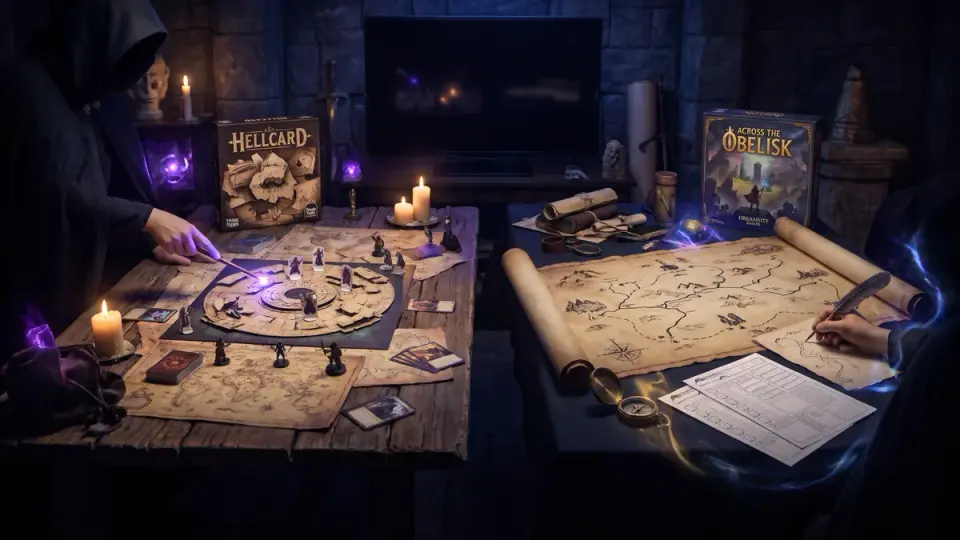
Pick the co-op deckbuilder that matches the decisions your group enjoys discussing, not just the cards it enjoys collecting. Both games are cooperative roguelike deckbuilders, both feature party building, and both carry the same difficulty and replayability rating. What separates them is where your group's attention goes during a session.
Choose Hellcard if your best conversations happen inside the current fight: where the enemies stand, who moves them, and whose card lands first. Choose Across the Obelisk if your group would rather split the party into roles, argue over which branch of the map to take, and build shared progression together over many runs.
One preference can flip the call. A tactics-first group should still take Across the Obelisk if the role split, the route, and the long-term progression are what will bring everyone back next week. A group of build planners should still take Hellcard if route debates and tracking unlocks sound like homework and the fight is where the fun lives.
Neither game owns one kind of planning. Hellcard still asks you to build a deck between fights, and Across the Obelisk fights still reward tactical play. The question is which conversation each game puts at the center of the table.
The quick choice for your group
Four decisions matter to a co-op group: what you coordinate during combat, how party responsibilities connect your choices, what shapes the run beyond one fight, and what kind of continuing investment keeps you returning. Here is how the two games line up.
| Decision | Hellcard | Across the Obelisk | What it means for you |
|---|---|---|---|
| Combat focus | Shared circular battlefield | Complementary party roles | Geometry talk vs. duty talk |
| Party link | Separate decks, one board | Roles that cover each other | Set up teammates vs. cover them |
| Run shape | Dungeon descent, fight by fight | Branching runs | Solve now vs. plan the route |
| Between runs | The next battlefield | Shared progression | Fresh fights vs. growing investment |
| Features | co-op or multiplayer, party building, positioning | co-op or multiplayer, party building | Positioning is Hellcard's headline |
| Difficulty | medium | medium | Neither is the gentle pick |
| Replayability | high | high | Both reward repeat sessions |
| Tone | dark | fantasy | Papercraft gloom vs. classic fantasy |
| Release date | February 1, 2024 | April 8, 2021 | Hellcard is the newer game |
Hellcard is set in the Book of Demons papercraft world, which gives its dark tone a handmade, pop-up-book look. Across the Obelisk sits in more traditional fantasy territory. Tone matters less than the four decisions above, but it can settle a tie in a group that cares about atmosphere.
What you coordinate during combat
This is the biggest difference between the two games, and the one your group will feel in the first ten minutes.
Hellcard turns the battlefield into the shared problem
Hellcard puts you and up to two friends, or AI companions, on a circular battlefield. Enemies stand at either melee range or ranged distance, and that placement decides which cards can reach them. Positioning is the state of who is close and who is far. In Hellcard, it is the puzzle itself, not a backdrop.
Every player's cards depend on where enemies stand, and every player can change that. Displacement means moving an enemy: shoving it back, pulling it in, or otherwise rearranging the board. An area attack, often called AoE, hits every enemy inside a zone rather than one target. Put those together and each turn raises three linked questions:
- Who needs the enemies where? A melee-heavy hand wants threats close. A ranged hand wants them at distance. These goals conflict, so someone has to concede or reposition.
- Can we bunch them for an area attack? An area attack is only as good as the number of enemies standing in its zone. A shove that clusters three enemies can double or triple the value of a teammate's next card.
- What order do we play in? Displacement has to resolve before the attack that benefits from it. Play the area attack first and the setup is wasted.
That third question is where Hellcard's co-op shines. Your party's cards can reinforce each other or compete, and sequencing decides which. A shove played at the right moment is a gift to the teammate who goes next. The same shove played carelessly can push an enemy out of the range your friend's whole hand was built to hit.
So the table talk in Hellcard sounds like "hold your attack, I'll pull the archer in first" or "don't push that one, I've got melee only this turn." If your group enjoys that kind of shared spatial puzzle, Hellcard is built around it.
Across the Obelisk centers combat on party roles
Across the Obelisk's combat conversation is organized around who does what. Each hero in the party belongs to a class, Warrior, Scout, Mage, or Healer, and each class draws from its own card pool. Party roles are the jobs those classes fill: soaking damage, dealing it, and keeping everyone alive.
The coordination question here is less "where is the enemy?" and more "who is covering which threat?" Does the Warrior's protection hold this turn? Does the Healer need to spend the turn on recovery instead of utility? Is it time for the damage heroes to go all in? Across the Obelisk fights have plenty of tactical decisions, but the role split frames how your group reads each turn.
If your group would rather debate geometry than duties, lean Hellcard. If "you tank, I'll heal, they burst" sounds like the fun part, lean Across the Obelisk.
How party responsibilities connect your choices
Both games give you reasons to think about teammates instead of judging your own picks in isolation. They get there differently.
Hellcard links separate decks through one board
In Hellcard, each player builds an individual deck. You own your reward picks, but their value depends on a battlefield your teammates are constantly changing. A card that looks mediocre alone, like a modest shove, becomes strong when a teammate's deck is full of area attacks that want clustered enemies.
That shapes reward picks. When you are offered cards after a fight, the useful question becomes "what does my deck add to the board the party shares?" A player who keeps taking cards that only work on enemies at one range, while a teammate keeps pushing enemies to the other range, has built a deck that fights the party. Hellcard rewards groups who talk about their decks openly enough to notice that early.
Across the Obelisk links roles that cover each other
Across the Obelisk ties your choices to teammates through responsibility. If the Healer drafts away from healing, the damage heroes die. If the Warrior skips protection, the Mage eats hits it was never built to survive. Each card reward gets weighed against the job that hero holds for the whole party.
An archetype is a recurring build pattern. In Across the Obelisk, archetypes form inside roles, so your group can decide together that the Scout leans into one damage plan while the Mage covers a different weakness. The conversation happens at the party level: what does the team lack, and which hero should fix it?
Hellcard asks you to set up your teammates. Across the Obelisk asks you to cover for them. Both are real cooperation; decide which one your group finds more satisfying.
Both games also support single-player, with Hellcard filling empty seats with AI companions. If you would rather run a whole team yourself than split it among friends, our guide to party-based deckbuilders for solo play covers that preference directly.
What shapes the run beyond a single fight
Run-level planning covers the choices that steer a whole attempt: rewards, routes, and resources between fights. The two games give this layer different weight.
Hellcard keeps the pressure on the current battlefield
A Hellcard run is a descent through papercraft dungeons. You build your deck as you go, and reward picks matter, but the run's tension mostly lives in the next battlefield. Each fight is a fresh arrangement of enemies at melee and ranged distance, and your party has to solve it with the decks you have.
For many groups, that is a feature. The planning horizon stays short and concrete: get through this fight cleanly, then improve the decks for the next one. Nobody needs to track a route three steps ahead to contribute, and the player who joined late tonight can still make the decisive shove.
Across the Obelisk adds the route as a group decision
A branching run lets the party choose between paths, so the route itself becomes something to plan. In Across the Obelisk, which branch you take shapes the fights, events, and opportunities you meet, and the whole party lives with that choice.
This connects back to roles. Some events offer options that depend on which classes are in the party, so a role split that looked sensible in combat can open or close doors on the map. Your group ends up planning on two levels at once: is the party built to win fights, and is it built for the route we want?
That second level is the core of Across the Obelisk's appeal for planners, and it takes time and attention. A group that wants to sit down and fight will find route debates a delay. A group that enjoys strategy meetings will find them half the fun.
Ask your group directly: do you want to argue about the path, or just about the fight?
Progression and the decisions you revisit
Separate three layers before deciding:
- Combat decisions: what you play this turn.
- Run-level planning: rewards, roles, and routes within one attempt.
- Progression between runs: what your group builds up over many attempts.
Hellcard puts its weight on the first layer, with deckbuilding as the second. Across the Obelisk spreads its appeal across all three, and its shared progression is the clearest difference at the third.
Why shared progression appeals to a returning group
Shared progression gives a regular group something that belongs to all of you. A failed run still feeds a common effort, and the next session starts with a sense of where the group stands. For a group that meets weekly, that continuity can be the hook that keeps the schedule alive.
Progression changes what your group has to work with; it does not make the role split or the route choice for you. A group that loves progression but dislikes run planning will still spend most of each session on the run.
If the campaign structure matters more to your group than the co-op itself, our list of deckbuilding RPGs with a campaign focus is the better next stop.
Judge commitment by what you want to revisit
Both games rate high on replayability, so the commitment question isn't which one lasts longer. It is which decisions your group wants to come back to.
Hellcard's replay pull is the next battlefield. Every fight reshuffles the positioning puzzle, and every new combination of decks changes which setups are possible. Groups that love solving fresh tactical problems will keep returning.
Across the Obelisk's replay pull is layered. You revisit the role split, try a different branch, and push the group's shared progression further. Groups that enjoy a long-running project, with each session building on the last, will feel that pull more strongly.
Choosing together as a group
Work through these four questions in order. Stop at the first one that gets a clear answer from most of your group.
- What combat discussion do you enjoy most? If the answer is enemy placement, shoves, area-attack setups, and play order, choose Hellcard. Switch to Across the Obelisk if the group admits the fight is fun but not what brings it back.
- How much do you care about complementary party responsibilities? If assigning tank, healer, and damage duties and drafting to fill gaps sounds like the best part, choose Across the Obelisk. Switch to Hellcard if your group would rather each player own a deck and coordinate through the board than hold fixed jobs.
- Do you want branching-run planning to shape your sessions? If route debates and role-dependent events excite you, choose Across the Obelisk. Switch to Hellcard if anyone at the table would rather skip the map talk and get to the next fight.
- Is shared progression a real draw? If a long-running group project will keep your schedule alive, choose Across the Obelisk. Switch to Hellcard if your group plays irregularly and wants each session to stand on its own.
If your answers split, let question one decide. The fight is where you will spend most of your time, so the combat conversation your group enjoys should outweigh the layers around it.
The clearest call: Hellcard for a group that wants to solve a shared battlefield together, and Across the Obelisk for a group that wants to run a party campaign together. If neither fits what your group described, browse more co-op deckbuilding games and use the same four questions to judge each one.
Games In This Article
Written by Glyphshuffle
Contributor at GlyphShuffle