Developer documentation and gameplay screenshots.
Cobalt Core vs Slay the Spire: Cards, Crew and Movement
Choose between Cobalt Core's ship positioning and mixed crew decks, and original Slay the Spire's character cards, relics, and route decisions.

Play Cobalt Core next if you enjoy Slay the Spire's hand-by-hand decisions and want positioning to change the answer. Stay with Slay the Spire if learning a character's cards and shaping a deck around its rewards is still the main attraction.
Cobalt Core adds a practical question to the familiar attack-or-defend turn: where should the ship be when those cards resolve? A movement option can help you avoid a firing lane while changing what your own cannon can hit. That is the reason to consider it after Spire; the spaceship theme alone tells you much less about whether you will enjoy it.
This comparison concerns the original Slay the Spire, not Slay the Spire 2. It uses the developers' descriptions and the actual gameplay images below. The recommendations are about player preference, without a claimed win-rate, completion-time, or difficulty advantage.
The hand has to work at the right distance

Gameplay image from our game library. Credit: Rocket Rat Games / Brace Yourself Games.
Look at the Cobalt Core hand above. Basic Dodge, Flex Move A, Lunge, and Multi Shot are visible. The opposing ship has several marked attack lanes, and your own ship occupies only part of that space. The hand and the alignment have to be read together.
The publisher's description identifies dodging attacks, targeting weak points, and lining up cannons as central to its single-axis combat. Movement therefore belongs in the same decision as damage and defense. A card that moves the ship is changing the encounter, rather than filling a generic utility slot.
Consider a turn where a horizontal shift would clear the relevant incoming shots. That move can be attractive even if it contributes no direct damage. But check where it leaves your cannon: a safe position that spoils an important shot may require a different sequence or another answer in the hand. This is an illustrative decision to inspect on the current battlefield, not a promise that any one move dodges every attack.
That is a good fit for players who enjoy revising a turn after noticing one more consequence. You are evaluating a sequence in a visible space as well as deciding which cards are individually efficient.
Skip it for this particular reason if spatial checking feels like extra housekeeping. It remains a card game, but the positioning problem is part of what you are buying. Wanting another deckbuilder does not automatically mean wanting another board state to track.
Choose the card pool you want to learn
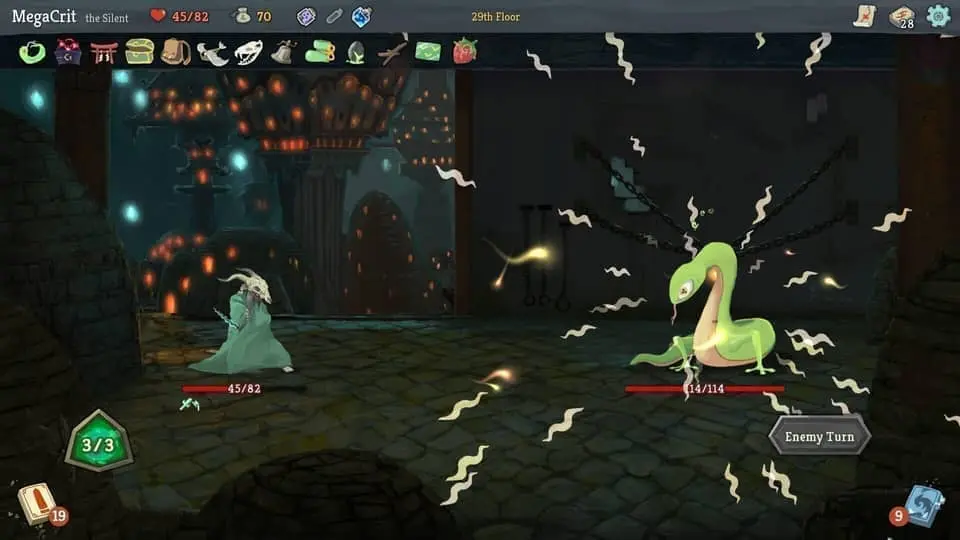
Original Slay the Spire gameplay from our game library. Credit: Mega Crit.
Slay the Spire's official feature description centers its core characters and their distinct cards. Its PC store page describes adapting the deck to encountered cards, choosing a route, and combining it with relics. That gives a new run a familiar starting identity while leaving its eventual direction open.
Cobalt Core starts with a different selection problem. You bring three crew members, mixing their decks; the publisher also describes character-and-ship combinations, branching card upgrades, and unlockable playstyles. You are choosing a combination of contributors before judging the cards offered during the run.
If you enjoy asking what an ally contributes in Monster Train, that part of Cobalt Core may appeal. The useful habit transfers: identify what each card pool contributes to the current plan. The mechanics do not transfer wholesale—crew cards are not Monster Train units or floors. Our Monster Train clan-pairing guide explains that role-based way of thinking in its own game.
For a concrete drafting question, suppose your current Cobalt Core hand keeps producing attacks while you struggle to reach a useful position. Another exciting attack may improve the turn you wish you were getting. A suitable movement option may help the cards already present do their job. Reverse the question when you can reposition comfortably but cannot finish the enemy. Draft for the demonstrated shortage rather than collecting more of your favorite role.
Choose Spire if you want to concentrate on learning one core character's card language across varied rewards. Choose Cobalt Core if experimenting with a crew combination sounds like part of the fun before the first fight.
Compare the decisions you want to repeat
The long-term purchase test is the recurring decision, rather than the size of a card list.
In Cobalt Core, ask whether you enjoy checking alignment again after a movement or attack changes the situation. The spatial layer makes a hand interesting when a different order changes what connects. Its cost is attention: recognizing a good card in isolation does not finish the turn.
In Slay the Spire, consider how much you still enjoy adapting to the next card, relic, and route choice. A reward that looks exciting can still fail to address the deck's immediate needs. If that ongoing drafting problem is what keeps you returning, you do not need a movement system to justify another run.
Both choices reward paying attention to the current problem. There is no reason to describe one as the universally better teacher, or assume a smaller-looking battlefield makes the other easy.
A useful first-run habit in Cobalt Core is to name the purpose of a move before playing it: avoid this lane, create that shot, or prepare the next sequence. Then inspect the resulting alignment. That makes movement an intentional part of the plan instead of a reflexive response to a threatening number.
Story can decide a close call
Cobalt Core's publisher explicitly presents crew stories and an unfolding time-loop mystery as part of progression. If you want recurring characters to give repeated runs another thread to follow, that is a concrete reason to put it on the shortlist.
It does not remove the combat tradeoff. Someone who dislikes alignment checks should not buy it solely because the crew is charming. Equally, a Spire player who enjoys the tactical loop but wants a different atmosphere has a stronger reason to try Cobalt Core than simply chasing a larger catalog of cards.
Our pick
For an existing Spire player seeking a different turn-level problem, pick Cobalt Core. The real addition is movement that interacts with incoming fire and your own attack alignment, supported by crew combinations you choose before a run.
For someone still absorbed by character cards, relic interactions, and route decisions, keep playing original Slay the Spire. Cobalt Core offers another set of decisions to learn; it does not make the familiar ones obsolete.
If you want more alternatives before choosing, the games-like-Slay-the-Spire guide covers the wider field. Start by deciding which part of a run you want to change: the cards you draft, the team supplying them, or the space in which you play them.
Games In This Article

Written by Roy Levy
Writer and editor at GlyphShuffle
Roy Levy is a full-stack developer and strategy-game enthusiast who writes and edits GlyphShuffle content focused on roguelike deckbuilders, deckbuilding games, and card battlers. He's especially interested in run structure, build variety, and the small design choices that make one deckbuilder click for a certain kind of player.